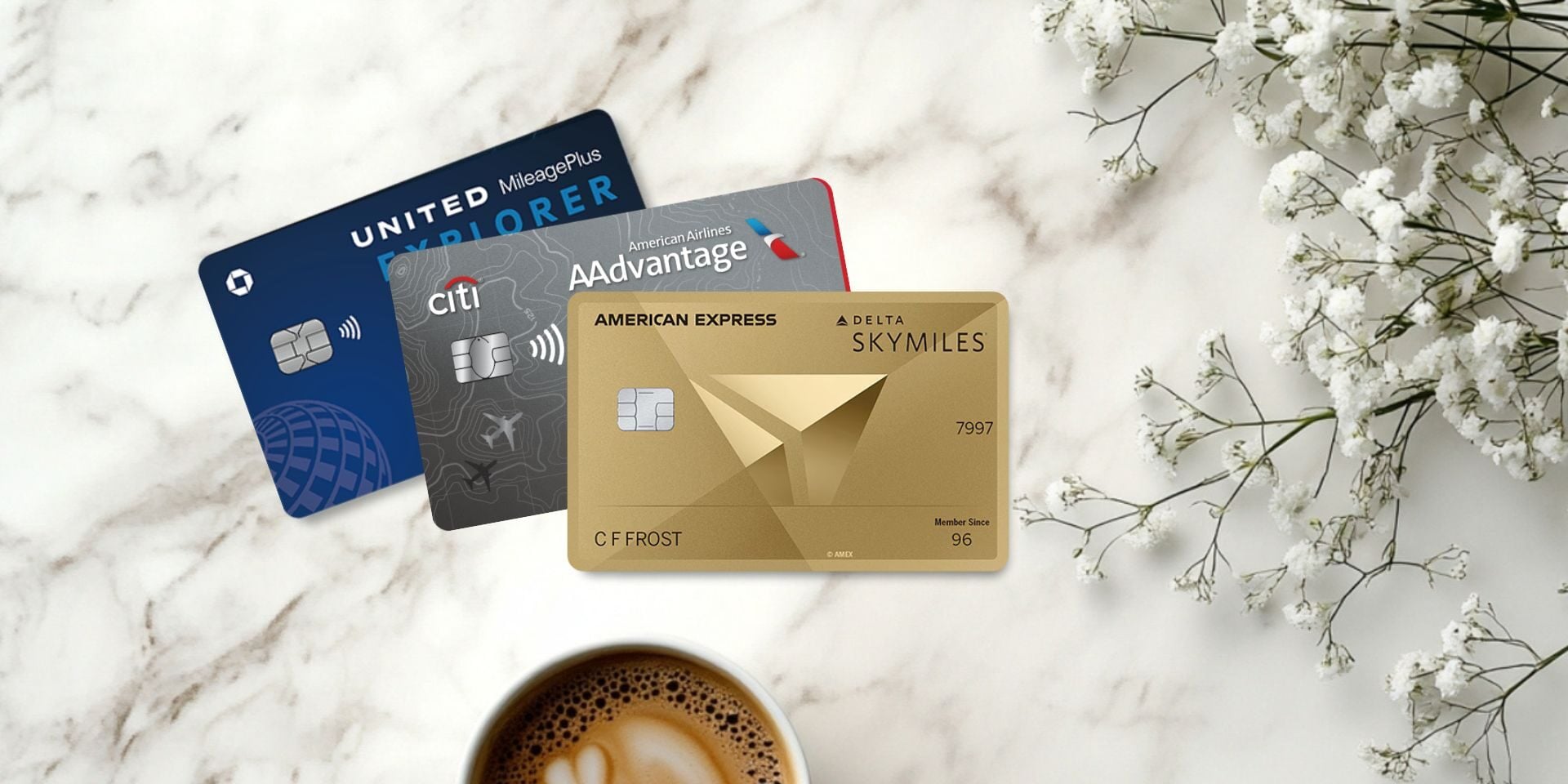



It’s practically canon in the world of award travel: Credit cards from banks like Chase, Amex, Capital One, and others – the ones that allow you to transfer points to a dozen-plus airlines and hotel chains – are the gold standard. But changes in the travel industry have us rethinking whether co-branded airline cards deserve a hard, second look.
Airlines are raising bag fees (again), further restricting travelers buying basic economy tickets, and – most importantly – increasingly offer better award pricing to cardholders. And that makes the case for picking up one (or several) airline cards stronger than ever.
That doesn’t mean you should swipe a Delta, American, United, or Southwest card everywhere you go – just the opposite. But they’re worth having for the benefits, even if you keep them in a drawer at home.
Each of the major U.S. carriers offers a portfolio of cards ranging from a no-frills, fee-free edition to an ultra-premium (and pricey) card, tailored to business travelers and really frequent flyers. For most travelers, even one or two trips a year with an airline can be all it takes to justify carrying even their pricier co-branded cards.
From free checked bags to discounted award tickets, priority boarding, and more, here’s why having a credit card with your favorite airline’s logo on it can pay dividends for your future travels.
Related reading: The Best Credit Cards to Get Started With Travel
Free Checked Bags
This is a big one. Airlines love ancillary revenue, and there’s no bigger source of it than checked bag fees.
Consider this: U.S. airlines collected nearly $7.5 billion (with a b) on bag fees alone last year … and they were on track to shatter that record in 2026.
Bag fees vary (a little) from one airline to another, but at a bare minimum, you can expect to pay $45 to check a bag these days … in each direction. Those fees are up this year after every major U.S. airline raised fees under the cover of increased fuel costs, due to the war in Iran. JetBlue took things a step further this week, raising checked bag fees to a minimum of $50 each way. Other airlines are bound to follow.
Here’s where things currently stand for each of the four largest U.S. airlines for domestic flights:
- American Airlines: $45 for your first checked bag when paid online in advance, or $55 at the airport.
- Delta Air Lines: $45 for your first checked bag.
- Southwest Airlines: $45 for your first checked bag
- United Airlines: $45 for your first checked bag when paid in advance, or $50 at the airport
A single roundtrip flight with a checked bag will cost you at least $90 when flying with one of the big four U.S. airlines. If you’re traveling with the whole family, it’s even more costly. And that’s where having a co-branded airline credit card comes in.
One of the best perks of carrying an airline credit card is getting free checked baggage on domestic flights – and most of the time, this benefit even extends to anyone traveling with you as long as you’re all booked on the same reservation.
Considering that most cards that include one free checked bag charge an annual fee around $150, it’s not hard to come out ahead with a couple of flights each year. If you’re traveling with friends or family, it might only take one roundtrip for the math to make sense.

Over the last few years, we’ve seen airlines widen the gap between what they’re charging for basic economy and main cabin tickets. Along with this price difference, they’re also (in many cases) decreasing what comes with a basic economy fare. While American and Delta still allow basic economy travelers to bring a carry-on, United doesn’t.
If you’re willing to roll the dice and book United’s lowest fares, paying for your flight with the airline’s co-branded card is the only way to avoid extra baggage fees.
Discounted Award Tickets
Delta pioneered this perk a few years back, adding TakeOff 15 to nearly the full suite of Delta SkyMiles credit cards. With this benefit, you’ll get a 15% discount on each and every Delta-operated flight you book using SkyMiles. Unlike other credit card benefits that give a rebate when you redeem points for a flight, Delta’s TakeOff 15 isn’t a kickback – it’s a true (upfront) discount on the award price.
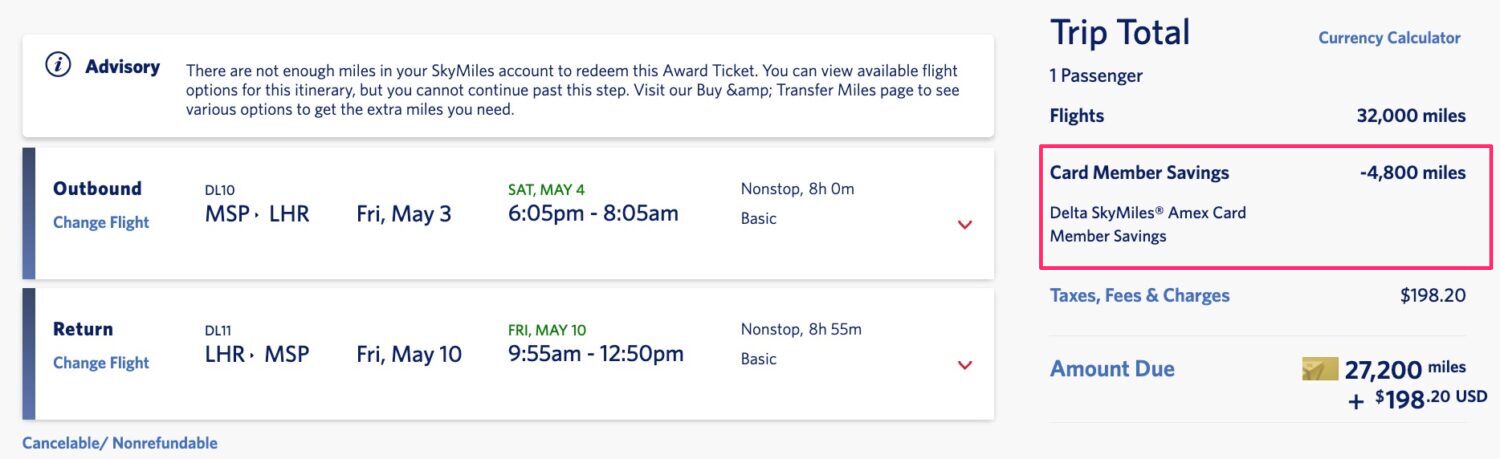
United introduced a similar perk when it revamped its co-branded cards earlier this year. All primary United cardholders now get at least 10% off award tickets on United-operated flights. Have United Premier status, too? That jumps to 15% off.
That means a 15,000-mile economy award drops to 13,500 miles, while a 200,000-mile business class seat falls to 180,000. With elite status, the savings are even greater.
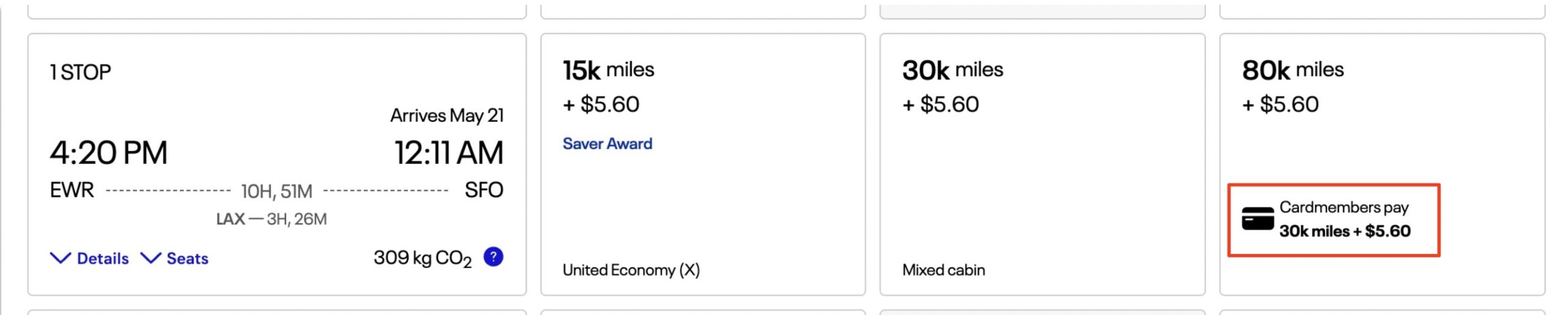
But United took things a step further, giving cardholders access to a pool of cheaper “saver” award seats that everyday United flyers simply can’t see – especially in business class. United has been quietly carving out this inventory for cardholders and elites for years, but now it’s front and center.
Search for an award with a card linked to your MileagePlus account, and you’ll see “Cardmembers pay” banners with dramatically lower prices than the rest of the world sees.
How dramatic? We often see Polaris business class awards from Chicago-O’Hare (ORD) to London-Heathrow (LHR) for 72,000 miles with a United card … a savings of 128,000 miles over what non-cardholders were quoted.

And it’s not just Europe, either: Cardholders can fly Polaris to Asia and Australia for as low as 90,000 miles one-way. Or score a smaller (but still substantial) discount on transcontinental routes like Newark (EWR) to San Francisco (SFO).
This cardholder-only award space is the reason United Polaris has gotten borderline impossible to book through partners like Air Canada Aeroplan or Avianca LifeMiles. United is keeping those seats for its own cardholders … and making its cards a practical must-have.
Read more: Better Biz Class Availability for United Cardholders
Priority Boarding
Getting a free checked bag and cheaper award redemptions are easily the biggest and most valuable perks for many travelers holding a co-branded airline card … but it’s not the only one.
All the major U.S. airlines also give their cardholders priority boarding as a benefit. This means that instead of finding one of the last groups on your boarding pass, you’re more likely to get on shortly after airline elite members and first class passengers.
For some travelers, this benefit might not mean much; the less time stuck in a metal tube, the better. But for anyone who’s had to fight for coveted overhead bin space, getting on before the other passengers in your row can mean the difference between storing your carry-on within arm’s reach and walking to the back of the plane to find a spot.
Worse yet, if your flight runs out of overhead bin space, you could be forced to gate-check your bag, which means waiting for it after deplaning. If you’ve got a tight connection, even a minor wait can be the difference between making your flight and not. And even if you’re not connecting, waiting for a bag is still a hassle.
Other Perks & Travel Credits
Things like a free checked bag and priority boarding are pretty standard for all airline cards … at least those that charge an annual fee. From there, each airline further sweetens the deal with additional “money-saving” credits, travel perks, and other benefits – exactly what you get depends on the airline (and the card).
Delta provides an annual credit for hotel bookings made through its Delta Stays travel portal, discounts on in-flight purchases, and a monthly rideshare credit (starting in year two).
United gives cardholders two one-time guest passes to access its United Club lounges, a credit for Global Entry, TSA PreCheck®, or NEXUS, and more than $400 per year in statement credits, divided into different allotments. Getting full value out of these statement credits is tough – if not impossible – but they’re still a nice sweetener on top of the other perks the card offers.
After a recent revamp, American’s base-level card now comes with an annual $100 in-flight credit, a complimentary Walmart+ membership, a Global Entry or TSA PreCheck® credit, and some added travel protections.
If you’re willing to pay for a more mid-tier or premium version of these airlines’ credit cards, you can expect more perks such as annual companion passes, unlimited complimentary lounge access, and even more monthly and annual statement credits. Generally speaking, the higher the fee, the greater the perks.
Best Co-Branded Card For Each Airline
There’s no one-size-fits-all answer to this question. Ultra-frequent flyers, like those traveling for business, might be better off ponying up for a top-of-the-line airline card to take advantage of additional perks like lounge access and a fast track to elite status. But for most leisure travelers, it makes sense to start at (or near) the bottom and pick a card with a more modest annual fee.
While each airline offers a no-annual-fee card, you can generally skip these as they don’t offer much in the way of benefits and there are more rewarding ways to earn each airline’s miles.
Delta Air Lines
For even the most occasional Delta travelers, the best co-branded card is the *delta skymiles gold card*. With the ability to earn SkyMiles and get added benefits, like free checked bags for you and up to eight companions on the same itinerary, holding this card can be a no-brainer.
In addition to the card’s welcome offer and generous checked baggage allowance, you’ll get an annual $100 hotel credit when booked through Delta Stays, a monthly rideshare credit (starting in year two), a 20% savings on in-flight purchases, priority boarding, and 15% off award bookings simply for being a card member.
By starting with the Delta SkyMiles Gold Card, you’ll also be eligible for additional new card welcome offers down the road if you decide a more premium version of the card is a better fit for you and your travels.
Here is the card’s current welcome offer: bonus_miles_full
Read our full review of the Delta SkyMiles Gold card!
Learn more about the *delta skymiles gold card*.
United Airlines
Just like Delta, the easiest way to beat these bag fees is by holding one of United’s co-branded credit cards like the *united explorer*.
By holding the United Explorer card, the primary cardholder and one companion traveling on the same reservation will each receive their first standard checked bag free. But unlike other airline cards, there’s a catch with this one: You have to pay for your ticket with the United Explorer card in order to get those benefits.
And if you plan to redeem United miles for an upcoming trip, this card is more essential than ever with the new award discount and expanded saver availability.
The United Explorer Card currently comes with a big bonus offer: bonus_miles_full
Plus, the card offers a annual_fees, making it a great card to have even if you only have one or two upcoming trips on United.
In addition to free checked bags, with this card you’ll also get priority boarding, two one-time United Club passes per year, hundreds of dollars in statement credits, and more.
Read our full review of the United Explorer Card!
Learn more about the *united explorer*.
American Airlines
The Citi® / AAdvantage® Platinum Select® World Elite Mastercard® is the best starting point for most travelers. With this card, you’ll get one free checked bag for the main cardholder and up to four companions traveling on the same domestic itinerary, simply for being a card member.
Even if you’ve already booked your flight, it’s not too late to take advantage of this benefit. As long as you open your card seven days before departure and attach your AAdvantage number to the reservation, you’ll get the option to check your bags for free when you check in for your flight.
This card also includes priority boarding, up to $100 in statement credits for in-flight purchases, complimentary Walmart+ membership, and a credit for TSA PreCheck or Global Entry. The card has a $0 introductory annual fee, then $150 per year.
Here is the current welcome offer: Earn 50,000 miles after spending $2,500 in the first three months.
Read our full review of the Citi AAdvantage Platinum Select World Elite Mastercard!
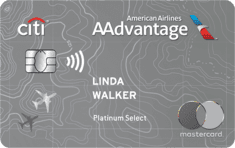
Learn more about the Citi® / AAdvantage® Platinum Select® World Elite Mastercard® (For full disclosure, this is not an affiliate link).
Bottom Line
As airlines raise baggage fees and strip away benefits for many travelers, having a co-branded airline credit card in your wallet can be a sneaky way to beat the airlines at their own game.
From free checked bags to discounted award tickets, priority boarding, annual statement credits, and more, having a card with your favorite airline’s logo can make up for the modest annual fee.