




My *chase sapphire reserve* annual fee comes due in early November, and if you had asked me in April, I would have told you I was all but certain I’d let the card die when that date arrived.
Today, I’m not just planning on keeping it: I’ve talked myself into it being one of the best-value cards in my wallet. That’s not because I misjudged the card at the start of the year. It’s because Chase has spent the past year quietly making it better, and I’ve realized that some “benefits” just simply aren’t worth much of my attention.
I originally got the Sapphire Reserve on the day it launched back in 2016, and held onto it for five years. In 2021, with COVID making a premium travel card hard to justify at the time, I downgraded to the cheaper *chase sapphire preferred*.
Last summer, after Chase’s major update to the card, which added new credits and raised the annual fee to annual_fees, I switched back to the Reserve. Part of that was personal curiosity … but it’s also quite literally my job to know these premium travel cards intimately, and there’s only so much you can understand about a card from the outside looking in.
I mostly went in thinking of it as a one-year experiment – but almost a full year later, I’ve changed my tune.
Why I Almost Bailed
A few things had me convinced I’d be downgrading again the moment my fee came due.
The Edit by Chase Travel℠ – the card’s curated hotel collection with an up to $500 annual credit (up to $250 twice a year) – was the biggest one … for two separate reasons.
First, the properties just didn’t fit well into how I actually travel, and finding one in a city I was planning to visit took more digging than it should have. On top of that, the credit itself was (at the time) locked into two rigid six-month windows: $250 to use between January and June, another $250 between July and December. Miss a window without a qualifying stay, and that money was simply gone. I really don’t need more cards offering hotel credits – especially ones that are hard to use.
Chase fixed that structure starting this year, removing the calendar split so both $250 credits can now be used at any time during the year. Combined with a handful of third-party tools that have popped up to make finding participating hotels easier, The Edit went from a credit I assumed I’d have a hard time using to one I’ve now used successfully.
The Apple Music and Apple TV credit was a similar story. When the Reserve relaunched, it only applied if you subscribed to those services individually. I was already paying for Apple One, Apple’s bundle plan, and the credit simply didn’t apply to it. That gap was a big part of my early skepticism – a marquee new credit that didn’t really save me much (if anything).
And then there was Hyatt. The hotel chain’s brutal devaluation in May made it much harder to justify keeping any premium card around solely for the 1:1 transfer ratio. If Hyatt points were worth less across the board, did it really matter which Chase Sapphire card I carried? It wasn’t until Chase cut Sapphire Preferred transfers to Hyatt down to a 4:3 ratio that the sting of Hyatt’s own devaluation started to feel less relevant to my decision. Suddenly, the Reserve’s 1:1 transfer rate mattered again, regardless of what Hyatt’s award chart looked like.
Add it up, and I spent a lot of my first six months annoyed by benefits that were nice to have but hard to use. Fixing those annoyances is one thing. Whether the card actually pays for itself is a separate question … and that’s the one that changed my mind.
The Tracker Doesn’t Lie
Chase’s own marketing for the relaunched Reserve touts more than $3,000 in annual value (their words, not mine). While that may technically be possible, it’s a number built by stacking every single credit at face value – whether or not a typical cardholder could realistically use all of them. For almost everybody, that figure is a stretch.
But “a stretch for almost everybody” isn’t the same as “worthless for everybody.”
I track every credit and benefit across my wallet using our own Credit Card Benefit Tracker, and when I ran the raw numbers on the Sapphire Reserve, I’d already recovered 100% of my annual fee. These are real credits I’ve actually redeemed, not Chase’s theoretical ceiling.
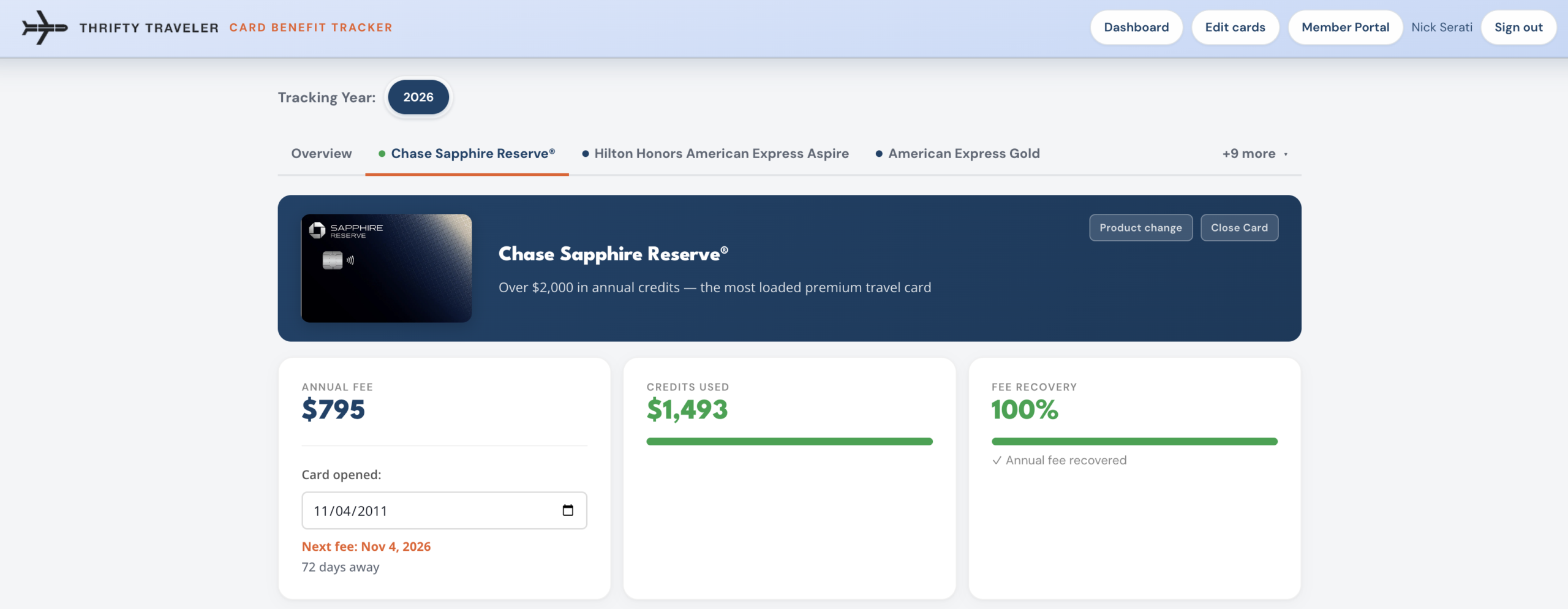
Here’s the breakdown, benefit by benefit.
The $300 Travel Credit
This is arguably the best benefit of any credit card in the market, and it’s certainly one of the easiest to use.
It’s an automatic $300 in statement credits every year for anything that codes as “travel” in Chase’s system, and that net is cast wide: flights, hotels, Airbnb and VRBO stays, car rentals, cruises, parking, tolls, rideshares, even public transit and campgrounds.
There’s no enrollment required, and no travel portal you’re forced to book through. You just spend on travel as you normally would, and the credit automatically chips away at your statement until it’s used up.
One detail worth noting: the credit doesn’t reset on January 1, as many other credit card benefits do. It reloads on your cardmember anniversary, right after your annual fee posts. Mine lands in November, so that’s when my next $300 shows up.
For most travelers (myself included), this single credit is nearly automatic, and that alone knocks my effective annual fee down to $495 each year ($795 minus $300).
Related Reading: All About the $300 Chase Sapphire Reserve Travel Credit
The Apple Music and Apple TV Credit
The Apple Music and Apple TV credit was a similar story to The Edit. When the Reserve relaunched, it only applied if you subscribed to those services individually. My Apple One plan bundles Music, TV, iCloud storage, and more into one monthly charge, and the credit simply didn’t apply to it under those original terms.
Chase fixed that gap earlier this year, and the credit now applies to Apple One subscriptions, too. I pay $39.95 a month for Apple One Premier because it gives everyone in my family access to all these services.
While my Reserve credit doesn’t cover the entire cost, it does cover $8 each month for both Apple Music and Apple TV ($16 total).
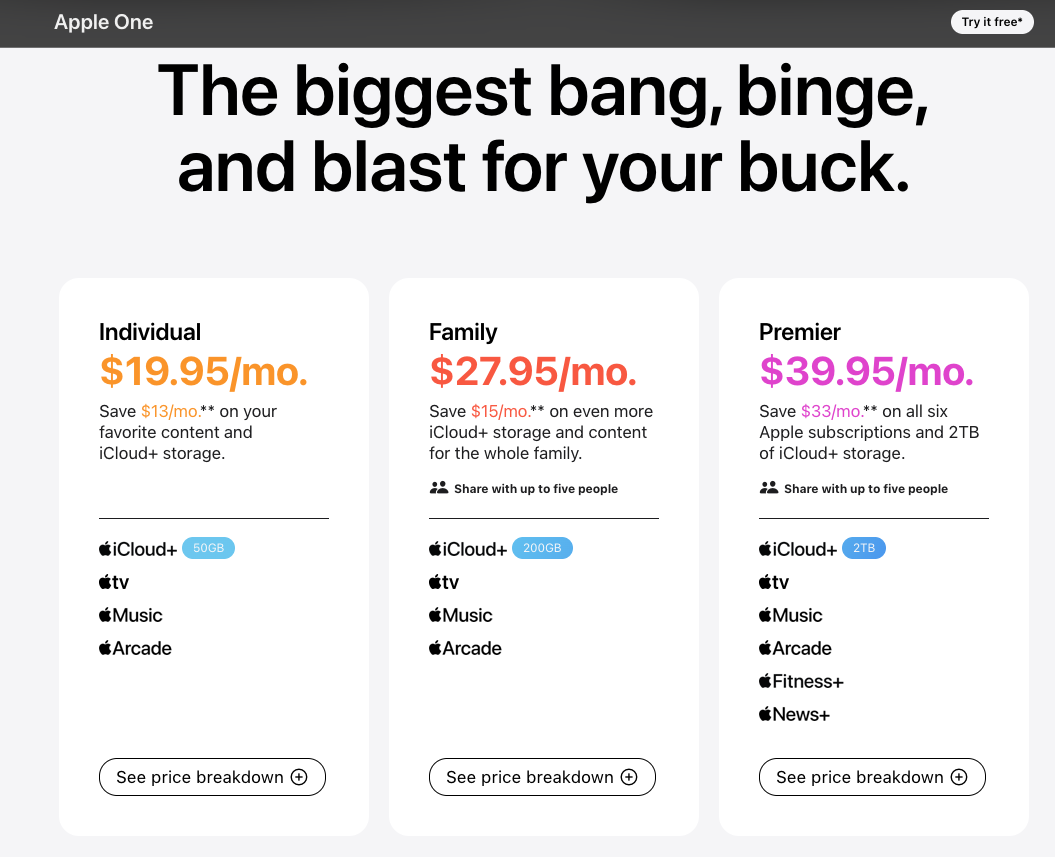
That’s $192 a year in savings on something I was already paying for, regardless of whether I had the Reserve card.
Officially, Chase’s marketing materials state that this benefit must be activated by June, 22, 2027. I’m hopeful this partnership will be extended beyond that point, as I am getting real value out of it.
Related Reading: Making the Most of the Chase Sapphire Apple Perks
The Peloton Credit
I’ve had a Peloton “All-Access” membership since the dog days of COVID in 2020 – long before I ever had the Reserve or this credit existed.

An “All-Access” membership costs $49.99 a month, and the Reserve knocks $10 off that once you activate the benefit and charge the membership to your Reserve card.
This isn’t a case of the card nudging me toward new spending. It’s another credit for something I was already paying for. Because of that, I value it at full face value: $120 a year.
Chase also offers 10x points per dollar spent on eligible Peloton equipment and accessory purchases over $150 (through Dec. 31, 2027), though I haven’t used it since I already own my bike.
The StubHub Credit
The Reserve now includes up to a $300 StubHub credit each year, split into two $150 windows every six months. If you’re not familiar, StubHub is one of the largest resale marketplaces for concert, sports, and event tickets – the same site you’d likely already turn to if you wanted seats to a show or a game.
I wasn’t especially excited about this one when I first got the Reserve card, but having six months to use up each $150 credit makes it easy enough for me to actually take advantage of. I attend enough live concerts and sporting events that I’m typically buying tickets for at least one event every six months anyway. This credit has just solidified StubHub as my first stop when I do … as long as StubHub’s prices are in line with other marketplaces. I’m not paying a $200 premium just to use a $150 credit.
Because that’s spending I was already doing – the credit just changed which site I use, not how much I’m willing to pay – I’m valuing this one at face value: $300.
DashPass and DoorDash Credits
DashPass is DoorDash’s paid membership program, which costs $9.99 a month, or roughly $96 annually if you buy it yourself.
It waives delivery fees and knocks down service fees on eligible orders from restaurants and stores on the platform. The Reserve includes a complimentary DashPass membership, plus monthly statement credits: $5 toward a restaurant order and two $10 credits toward non-restaurant orders, such as Walgreens or Target deliveries.
I wouldn’t pay full price for DashPass on my own, and I’m not counting this one at face value the way I do some of the Reserve’s other credits. Saving $5 a month on an order I might not have placed anyway isn’t quite the same as a dollar-for-dollar credit toward something I was already buying.
That said, I do order from DoorDash at least once a month, and the credits have quietly covered real purchases – over-the-counter medicine from Walgreens and a few quick household items from Target. At the end of the day, these benefits aren’t the reason I hold the card, but there is no question that it provides some value for me.
Conservatively, I’d put the real value at $100 a year.
The Dining Credit
The Reserve offers up to $300 a year in dining credit, split into two $150 windows every six months, redeemable at a curated list of participating restaurants that run on OpenTable’s Sapphire Reserve Exclusive Tables platform.
This is the benefit I’d call average at best, especially stacked against the footprint of Amex’s Resy dining credits.

Where I live in Minneapolis, there are only three participating restaurants.
Still, I found real uses for it. I burned through my first $150 on a weekend trip to New York, where the list of participants was much longer. And one of the three Minneapolis options is Baldamar, a restaurant I enjoy, and buying a gift card there triggers the credit, so if I’m ever at risk of letting the second half expire unused, I have a built-in way to redeem it at a place I know I’ll actually eat.
Would I have gone to that NYC restaurant without the credit? Probably not. But it still had real value. Conservatively, I’d put this credit at $150 (for the full year).
There’s also reason to think this credit only gets better from here. If Chase keeps expanding its OpenTable restaurant collection – and I have no reason to think it isn’t actively working on that – a thin list in a market like Minneapolis becomes less of a limiting factor over time. A credit that’s merely average today could be a genuinely strong one in a year or two, without me doing anything differently.
Related Reading: Breaking Down the New $300 Dining Credit on the Chase Sapphire Reserve®
Adding It All Up
Tally the travel credit, Apple One, Peloton, StubHub, DashPass, and dining, and I’m at $1,162 in credits I’m actually using … already well clear of the annual fee before “The Edit” even enters the equation.
I used one of my two Edit credits on a January stay at the Virgin Hotel in New York City. Add that $250, and I’m at $1,412. Even if I never touch my second $250 Edit credit this year, I’ve already come out comfortably ahead, and knowing that before I frustrate myself trying to use it makes a huge difference.
I’m already way ahead on my annual fee without having to work too hard. If my second “The Edit” credit works into my travel plans, great! If it doesn’t? I won’t lose any sleep over it.
And that’s without setting foot in a Chase Sapphire Lounge or filing a single claim under the card’s travel protections – trip delay, trip cancellation, and rental car coverage that regularly rank among the best offered by any card.
Those benefits are worth real money to plenty of cardholders. I just haven’t used them in my first year with the card … and the math still works for me without them
The Value That’s Harder to Put a Number On
Not everything shows up cleanly in a spreadsheet (or in our nifty benefit tracker tool).
I transfer Chase points to Hyatt often enough that the Reserve’s 1:1 ratio (versus the Preferred’s new 4:3 rate) makes a real difference in how far my points stretch, even after Hyatt’s own award chart made those points more expensive to use in the first place. It’s hard to assign a dollar figure to this, but it’s real … and it’s a big part of why the case for the Reserve is stronger now than it was when I upgraded.
The card’s Priority Pass lounge access matters too. Priority Pass is a membership that gives you access to a network of airport lounges worldwide, regardless of which airline you’re flying with.
I haven’t set foot in an actual Chase Sapphire Lounge yet, since none are near the airports I fly through most, but I have used the Priority Pass benefit itself several times, and Chase still includes two free guests every visit – a perk Capital One’s Venture X stripped out in a February policy change.

There’s a common thread running through everything on this list. The moment a benefit demands real effort, like a separate booking portal, obscure eligibility rules, or a redemption window I have to actively track, my interest drops fast. Almost nothing here asks that of me, and I think that’s a big reason why I have changed my tune on the Sapphire Reserve. Almost all of the value I am getting out of it doesn’t require me to change my behavior to redeem the credits, and that is worth a lot to me personally.
There’s a difference between recouping your annual fee and drastically changing your behavior and spending countless hours doing so.
Say someone actually captured Chase’s full advertised value of $3,000-plus. Good for them … but what did that require? Booking specific hotels through a specific portal. Tracking multiple credit windows on different cycles. That’s not nothing … and if you ask me, it’s closer to a part-time job than a credit card perk. How much is your time worth?
I’ve already made the case that almost everything I use on this card is automatic. What’s worth adding here is the flip side: that’s also my filter going forward. If a new Reserve benefit ever requires real active management to capture, I’m not going to bend my habits to chase it. The card has to keep fitting into my life, not the other way around.
This Isn’t a Blanket Endorsement
I want to be clear about what this story is and isn’t. This isn’t me telling every Reserve cardholder to relax and stop questioning the annual fee. It’s not even me saying “The Edit” credit is a waste for everyone. Plenty of people will get real value out of it if they travel differently than I do.
Card valuations like this are never one-size-fits-all. Like most things in points and miles, it’s personal – what makes the Reserve a keeper for me might not move the needle for someone with a different wallet, spending habits, or travel patterns.
You need to do the math for your own situation.
Bottom Line
My Sapphire Reserve annual fee hits in early November, and after actually tracking what I use instead of what Chase advertises, the Chase Sapphire Reserve is a keeper for me … at least for the next year.
Learn more about the *chase sapphire reserve*.




Nick,
So glad you posted the great article on the value of the CSR card! Yes, we do enjoy many of the credits & benefits – the $300 travel credit, $300 dining, $500 Edit hotels, $300 Stubhub, Apple TV/music, and Dashpass. We live in San Diego and have many dining options for Exclusive Sapphire tables. But for ANYONE living in San Diego (or city airport that includes a Chase lounge), I cannot give up the Chase Sapphire Lounge! I hope you get to experience it someday.
The other BIG reason to keep the card is the incredible travel protection. I had to use it in 2025, when my luggage never made it to my cruise ship in Spain, and took its own vacay for 20 days before showing up back home in the U.S.! Got $500 in funds to purchase clothes and travel items.
But sadly, I had to use it in May 2026 when I broke both my kneecaps in an accident in Cabo, while staying at a beautiful resort. I was able to use the $100K evacuation to travel home to San Diego by private Learjet and wind up in a hospital in La Jolla, versus surgery in Mexico. Since I am on a one-year recovery, I also was covered for cancellation of 2 other major international trips that included cruise, air, tours etc. CSR has the best travel protection on the market, something that hopefully most travelers won’t have to experience. Today, I stay home with my leg braces on, reading travel posts like yours, and fantasize where I will be traveling after May 2027, God willing!
Not a reply to the article – just a request for Nick – would love to see a tall man’s opinion on the best business class seats! After watching the latest TT Pod- your flight reviews are the ones that I want to read ( MY DH is 3’3″ and Son is 6’4″- both are built like linebackers). Between the shoulder width of the seat in lay-flat position to the the size of the footwell – these are big concerns to a big man —- Thanks in advance??
The CSR is, arguably, the best card in market for travel. Assuming that a chase point is worth between 1.5c and 2c (I got 2c when booking an Edit hotel on Chase using points), the cash back for buying airline tickets on Chase Travel is 12-16%. You can book IHG hotels for the same cashback. For other hotels chains, you cannot book on Chase Travel (otherwise your stay loses the loyalty benefits), but can still earn half of the above cashback by charging the hotel bill to CSR. It also provides primary insurance for car rentals, especially useful overseas, where most institutional contracts that include insurance do not work.
The door dash benefits are really nice – they have real value. I love the Edit and Open Table, but would only value them, each, at no more than $100 annually. If we look for a travel card that has benefits of this type, then Amex Plat. is much better at every aspect. Its hotel program is real, and its restaurant list is real (I value each at half the face value), and they have a lot of others. But Amex Plat. as a spending card is largely useless, vastly inferior to CSR.
Lastly, the airport lounge benefit of CSR is huge, unless you have a similar benefit from another card.
I also like the extra benefits at $75k spending. But this is really not a reason to own the card.