



Every year around this time, mailboxes (and inboxes) fill up with tax documents from banks, employers, and investment firms, all designed to help you report your income to the IRS. But there’s one place you typically don’t expect to hear from at tax time: your credit card company.
One of the many appealing things about points and miles is that they’re essentially funny money. Even though they can have very real – and sometimes immense – value, credit card rewards usually aren’t treated as taxable income. That is, until a Form 1099 shows up in the mail.
For the uninitiated, a 1099 is a common IRS form used to report various types of income. And whether your credit card rewards are taxable ultimately depends on how you earned them.
Did you rack up points by spending on your card or earning a big sign-up bonus? Uncle Sam doesn’t need to know about that. Refer a friend and earn points in the process? That’s a different story.
As you prepare to file your taxes this year, here’s what you need to know about when – and why – credit card rewards may count as taxable income.
Related reading: How & When to Pay Your Taxes With a Credit Card
Welcome Offer Bonuses
Signing up for a new credit card with a big welcome offer is one of the fastest ways to boost your points or miles balance. Few things accelerate future travel plans more than a large influx of rewards earned after meeting a card’s spending requirement.
Those bonuses – whether in points, miles, or even cash back – have clear value. They can unlock long-haul flights, luxury hotel stays, and plenty more. It would be reasonable to assume that value makes them taxable.
Thankfully, that’s not the case.
Because welcome bonuses require you to spend a certain amount — whether it’s $500 or $5,000 — the IRS treats them as a rebate on spending rather than income. The same logic applies to the points you earn on everyday purchases.
Take the *venture x*, for example – one of the most popular premium travel cards on the market. New cardholders can currently earn bonus_miles_full. Since Capital One miles can easily be redeemed for travel at 1 cent per mile, that bonus is effectively worth $750.

But because the card requires $4,000 in spending within the first three months, that $750 isn’t considered taxable income.
In the eyes of banks and the IRS, the bonus functions as roughly a 19% rebate on your spending. Without that requirement, you’d likely owe taxes on the bonus – significantly reducing its value.
See all the best credit card offers for travelers right now!
Referral Bonuses
Whether you’re new to points and miles or a seasoned pro, you probably know the value of having the right travel rewards credit card. It’s only natural to share that knowledge with friends and family — and referral bonuses make doing so even more appealing.
Over the past year, some of the best offers on the Amex Platinum and Amex Gold cards have been available only through targeted referral links. But unlike welcome bonuses, referral rewards usually don’t require any spending on your part. That distinction matters.
Because referral bonuses aren’t tied to spending, they aren’t considered a rebate – and that makes them taxable.

American Express caps referral earnings at 100,000 points per card, per year. Whether you earned 15,000 points or hit the full 100,000-point limit, you’re responsible for reporting the full value as income.
Although Amex allows Membership Rewards points to be redeemed for cash at just 0.6 cents apiece, the company values them at 1 cent per point for tax purposes. Earn 100,000 points through referrals, and you can expect a 1099-MISC reporting $1,000 in income.
Here's how it's spelled out in Amex's Referral Program (see terms & conditions):
“The value of the Referral Bonus may be taxable income to the Basic Card Member on the account that earns a referral bonus. The Basic Card Member is responsible for any federal or state taxes resulting from the Referral Bonus.”
American Express isn’t alone. Chase may also issue a 1099-MISC for referral bonuses — though the policy isn’t spelled out as clearly. Based on reports, Chase appears to use $600 as the threshold for reporting referral income to the IRS.
Here’s how Chase addresses tax responsibility in its referral terms:
“The value of this offer or program may result in miscellaneous income received from Chase and we may be required to send you, and file with the IRS, a Form 1099-MISC (Miscellaneous Information) or Form 1042-S (Foreign Person’s U.S. Source Income Subject to Withholding) for the year in which you participate and are awarded the benefits of the offer/program.”
Capital One follows a similar approach. If you referred friends or family to a Capital One card last year, you likely received – or will receive – a 1099-MISC.

Since Capital One miles can be redeemed for travel at 1 cent each, that’s the value used for tax reporting. Earn 50,000 miles through referrals, and you’ll need to report $500 as income — both federally and at the state level, if applicable.
Bank Account Bonuses
Bank account bonuses are almost always taxable. When banks offer cash bonuses for opening a new account and meeting certain requirements, those rewards aren’t tied to spending – and that means they’re reported as income on a 1099-INT.
But what happens when a bank bonus comes in the form of points or miles?
American Express, best known for its credit cards, also offers checking and savings accounts. One business checking account currently offers a bonus of 30,000 Membership Rewards points after completing several requirements:
- Deposit $5,000 or more within 30 days of account opening.
- Maintain an average account balance of $5,000 or more for the next 60 days.
- Make five or more qualifying transactions within 60 days of account opening.
What’s missing is any requirement to spend money. As a result, even though the bonus is paid in points, it isn’t a rebate — and it’s considered taxable income.
The same logic applies to the Bask Bank and its Mileage Savings Account, an online savings account that earns American Airlines AAdvantage miles instead of interest. The account currently earns 1.75 miles per dollar saved annually, with no minimum balance or monthly fees.

Miles are paid monthly, so keeping $10,000 in the account for a month would earn roughly 1,458 miles. Over a year, that adds up to about 17,500 AAdvantage miles.
Because those miles aren’t tied to spending, Bask reports them as income on a 1099-INT. While AAdvantage miles can easily be worth 2 cents or more when used strategically, Bask typically assigns a much lower value for tax purposes.
In past years, the bank has valued miles at 0.42 cents each. Earn 20,000 miles, and you’ll report just $84 in additional income.
How to Report 1099 Income
Whether you file your own taxes, use software like TurboTax or H&R Block, or work with a tax professional, you’ll need to keep track of any 1099 forms you receive.
If most of your income comes from an employer, you’re already familiar with the W-2. Think of 1099s as the equivalent … just for your non-employment income.
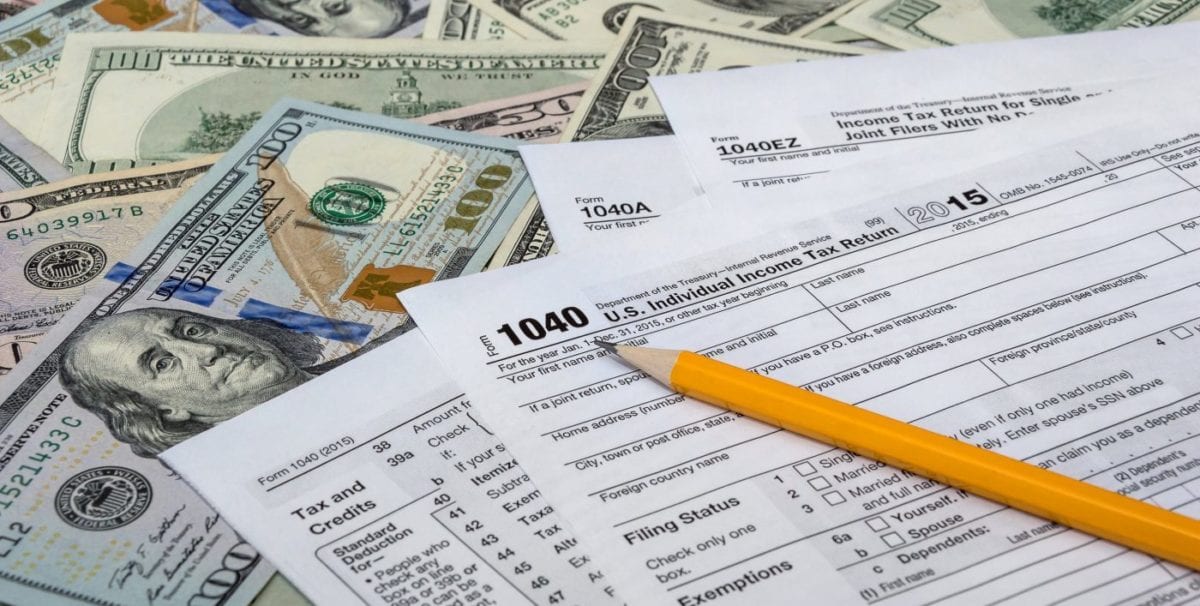
Form 1040 is the standard IRS form for filing individual tax returns. While much of it goes unused for many taxpayers, specific lines are dedicated to reporting income listed on 1099-MISC and 1099-INT forms. If you’ve ever worked as an independent contractor, you’ve already navigated this process – reporting points income isn’t any different.
Note: We’re not tax experts. Always do your own research and consult a qualified professional if you have questions.
If you’re filing on your own, expect your tax software to ask about additional sources of income after you enter your W-2. That’s where any 1099 income from credit card rewards or bank bonuses comes into play. From there, the tax prep program will guide you through the rest.
Bottom Line
Tax season often means an avalanche of paperwork from financial institutions. Understanding which credit card rewards count as income – and which don’t – can help you file with confidence and avoid surprises. Knowing the difference now will make tax time a whole lot less stressful.



I recently received a 1099-MISC form from Chase. Never got one like this before. Called the Phone Support number listed on the form to ask what it was for. Got bounced around from department to department. Finally, after repeating my name, card # etc, etc for the EIGHTH person I was referred to, I gave up and turned to Google, where I found your helpful article. I’m sure many people have had the same questions, so why on earth do their customer service people have no clue what we’re even asking????
There is no reason at all for Marriott Bonvoy to have issued a 1099 for $483.79, but now that they have, unless they agree to correct it with the IRS you are probably wise to include it in income when paying your taxes.
$600 is the IRS threshold for annual 1099 reporting. Below that, you are supposed to report miscellaneous income but almost no one actually does. So if you get $600+ in referral bonuses from a single payor in a calendar year, you should get a 1099, but if you get $599 or less, no. This has been the law for many years. (But there is a pending bill in Congress to raise the $600 threshold to $1,000, since the original figure was not indexed for inflation. That will sharply reduce the number of rewards-related 1099s issued, if it passes.)
I applied for a Chase United Airlines VISA and received an immediate $300 statement credit which went against a $1000 ticket purchase. I view that as a discount on the purchase price of the ticket.
Great info. Appreciate your telling us what we need to know (tax implications) in addition to what’s nice to know (great flight deals)!
This is very helpful, thank you Jackson. I receive 1099 forms from Chase this year for the firsr time. I have have referred people to both Chase and Amex in the past years and neved received these. Is this new, is there a new law requiring them to report it?
I received a 1099 for my Marriott Bonvoy Card from Chase. The card came with 5 free night certificates (50k each), after I spent $5k in purchases. Based on the article, and my own understanding, I don’t think this should have counted as income. I had to spend $5k to get those free nights. The amount of the 1099 is pretty random too, $483.79. I called Chase and they could not explain the amount or how it was calculated even after with 3 people for over an hour. What are your thoughts?
Hi Diana! First off, thank you for reading. To my knowledge, there wasn’t an update to the tax code this year that requires the banks to report points earned as income – it could just be a matter of them viewing it as a gray area and trying to cover their bases. Additionally, they all have their own internal limits for issuing 1099s so maybe in years past you didn’t earn enough points from referrals or they changed their thresholds.
That’s strange that you received a 1099 from Chase for the 5 Free Night Award offer on the Bonvoy Boundless Card. By all accounts, that should not be treated as income since it was part of a new card welcome offer. After doing a little digging, it appears you’re not alone in receiving one for this though. I can’t stress enough that I’m not a tax professional, though. If you have an accountant, I would certainly consult with them on this before deciding whether or not to report the income from the Bonvoy offer.