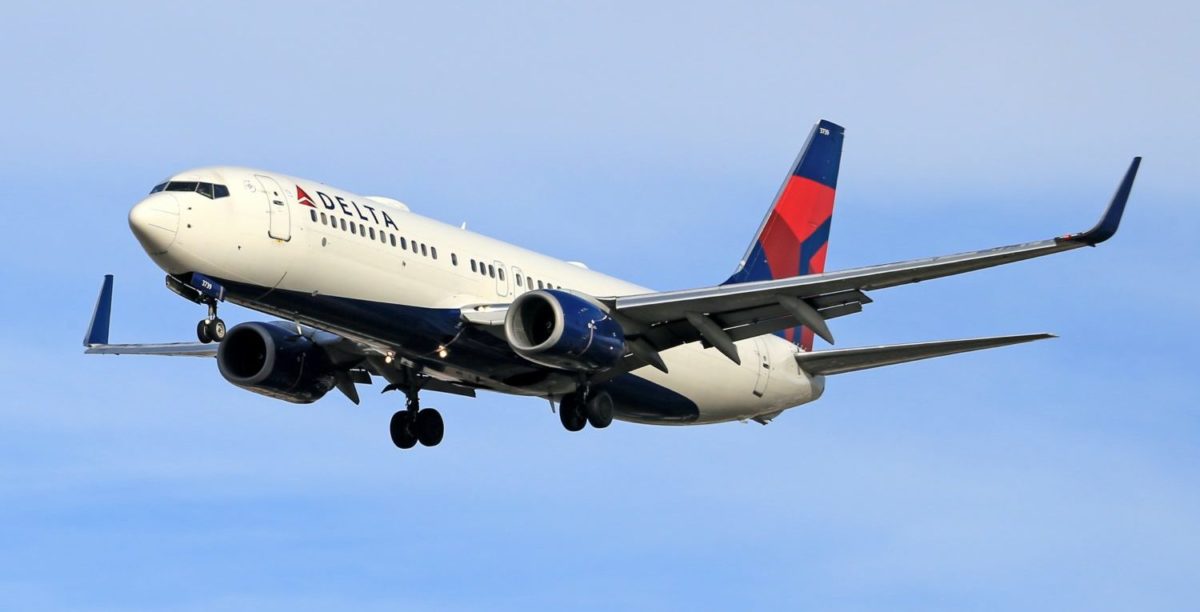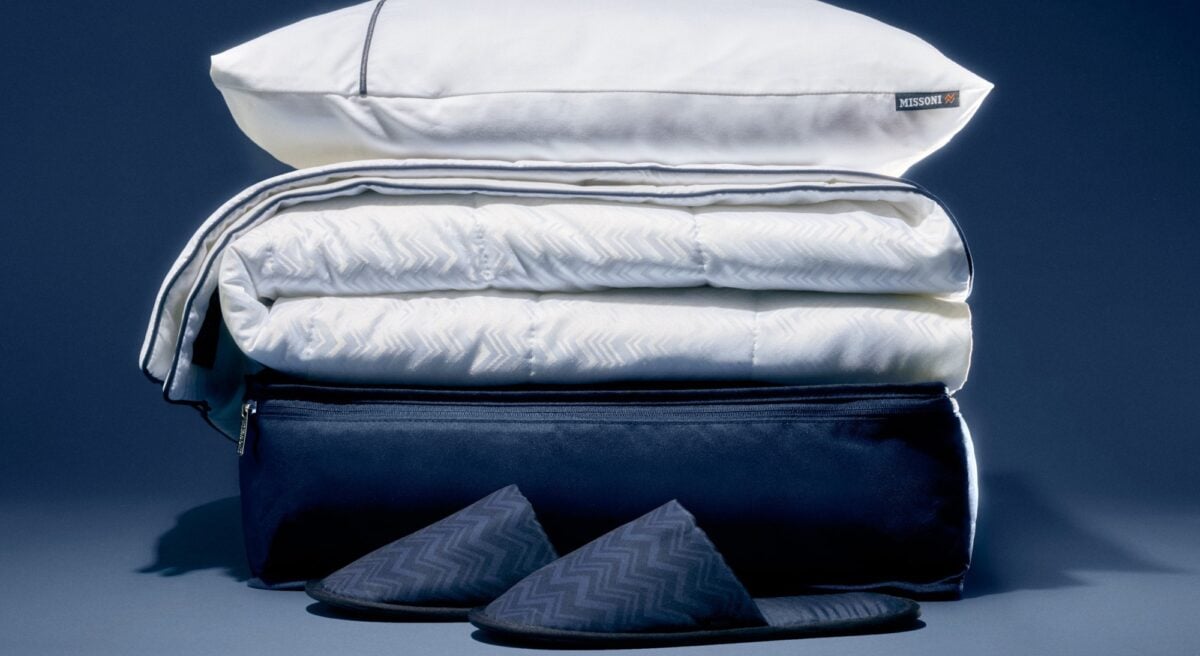



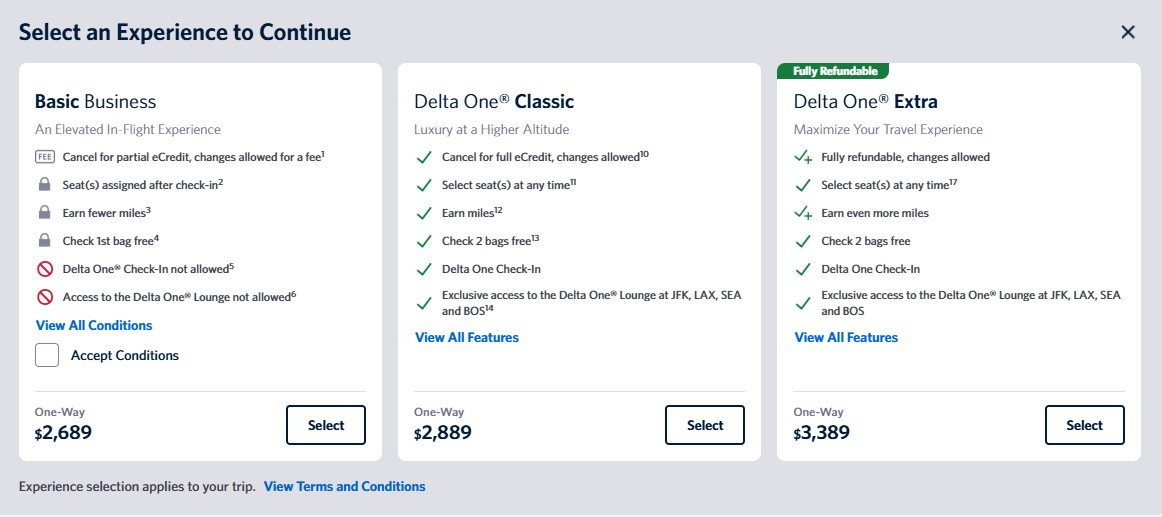
The writing had been on the wall for nearly a year now, but yesterday, the day finally came: Delta rolled out new “basic” fare classes for Delta One, Premium Select, and First Class.
Delta is framing this as a win for travelers, giving them more “choice” when booking. We see it differently: Basic fares are about charging more and giving travelers less, plain and simple.
When Delta pioneered basic economy more than a decade ago, prices didn’t drop – the airline just built a stripped-down product to sit alongside its regular fares – allowing them to charge more for what used to be included. The same thing happened when Delta launched Comfort Basic fares last November. Maybe we’re wrong, and this actually leads to lower prices for travelers willing to go without the premium perks like lounge access, advanced seat assignment, extra baggage allowance, and more that usually come with these fares – but the more likely outcome is that travelers end up paying the same price and getting less.
But this change doesn’t happen in a vacuum. It’s the latest in a string of moves that raise a bigger question: How much goodwill does Delta think it has left with the travelers who’ve paid a premium – literally – to stay loyal to the airline?
Want more travel news, deals, and analysis like this delivered straight to your inbox? Sign up for The Extra Mile, our free daily newsletter!
Higher Status Requirements
Delta has been chipping away at what “premium” means for a while now.
Three years ago, the airline made sweeping changes to how travelers earn Medallion status – and they weren’t subtle. Earning status these days is all about spending with Delta – and Delta measures that using Medallion Qualifying Dollars, or MQDs.
Top-tier Diamond status jumped from 20,000 to 28,000 Medallion Qualifying Dollars – a 40% increase. While lowly Silver Medallion status went from 3,000 to 5,000 MQDs, up 67%. That means you need to spend $5,000 a year with Delta just to earn the lowest-level Silver status … and a whopping $28,000 annually for the top-tier Diamond Medallion status.

And what do you get for that kind of loyalty? Less and less every day.
Complimentary upgrades to first class are harder than ever to come by as the airline would much rather sell those seats outright or offer travelers a cheap paid upgrade instead of giving them away to elites for free. We threw in the towel on elite status years ago, and think it’s high time other leisure travelers do the same – if you’re not flying on the company dime, loyalty (to any airline) simply isn’t worth it anymore.
Read more: Is Delta Status Really Worth It? All About Delta Medallion Status
Reduced Lounge Access
To go along with its increased status requirements, Delta announced it would cap Sky Club access for premium cardholders, too: Travelers with the *amex platinum* went from unlimited visits to just 10 a year (Feb. 1 – Jan. 31), while even the top-tier *delta reserve card* was capped at 15 lounge passes (Feb. 1 – Jan. 31).
The backlash was loud enough that Delta’s CEO Ed Bastian admitted the airline “probably went too far” and promised fixes were coming – and they did. But the airline’s goals and trajectory never really changed.

Fast forward to this week, and soon Basic Business fares will lose lounge access altogether – no complimentary Delta One Lounge or Sky Club visits on these tickets, unless you’re using a status perk or burning one of a limited number of visits on a premium card.
It’s the same movie we’ve seen time and time again: Delta keeps finding new ways to wall off the perks that used to be standard.
Outdated ‘Premium’ Seats
Delta calls itself America’s premium airline and prices fares accordingly, but the onboard product doesn’t always live up to that billing.
Don’t get me wrong, the airline’s fleet of newer jets with Delta One Suites is nice … and growing fast. But nearly half of Delta’s long-haul fleet still flies business class seats designed in 2011 or 2013 – older Boeing 767-300s and Airbus A330s with narrow seats, low-resolution 10-inch screens, and none of the closing privacy doors found on Delta’s newer Delta One Suites.

Book a Delta One fare today, and you’re rolling the dice among seven different business class configurations. Compare that to United, which has now finished retrofitting its entire long-haul fleet with a single, consistent Polaris seat – and is already onto the next upgrade (more on that below).
Delta has newer planes coming, but deliveries stretch into the next decade. In the meantime, paying business class prices – or redeeming hundreds of thousands of SkyMiles – still comes with a coin-flip chance of sitting in a seat that looks like it’s from a different era … because it is.
Minor Service Cuts Add Up
Back in May, Delta cut food and beverage service entirely on flights under 350 miles for anyone not sitting in First Class – about 9% of its daily flights, including routes like New York to Boston. For context, American and Southwest still serve passengers on flights as short as 250 miles, and United’s cutoff is 300 miles.
In fairness, snack service on these short flights was far from a given to begin with. If there was any turbulence along the way, flight attendants would have to remain seated, and there might not have been time for anything anyway.
But stack them next to the status changes, the lounge restrictions, the aging seats, and now Basic Business fares, and a pattern emerges: Delta keeps finding small, defensible-sounding ways to give travelers less for the same – or higher – price.
Lagging Performance
Delta has spent years marketing itself as the industry’s “on-time machine,” but the data increasingly disagrees.
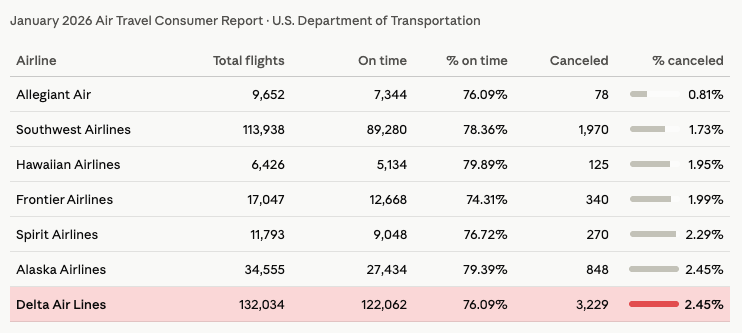
The Department of Transportation’s January 2026 Air Travel Consumer Report showed Delta had fallen from first to sixth place among U.S. carriers in reliability, according to an analysis from Simple Flying. Delta and its regional partners operated 132,034 flights that month and canceled 3,229 of them – a 2.45% cancellation rate, tied with Alaska Airlines for the worst mark among the majors. By comparison, ultra-low-cost-carrier Allegiant canceled just 0.81% of its flights.
That’s a startling reversal for an airline that held the top reliability spot for five straight years.
Back in July 2024, a global software outage briefly grounded systems industrywide – but while other carriers recovered within a day, Delta’s crew-tracking software buckled under the strain, and the airline canceled more than 5,500 flights in a week, more than all of 2018 and 2019 combined. The culprit: aging, in-house crew scheduling technology that couldn’t handle a surge of disruptions.
Nearly two years later, in May of this year, Delta suffered another meltdown – canceling more than 200 flights in a single day and citing vague “crew restrictions” – while American and United operated without major issues. Same root problem, different weekend.
Death by a Thousand Cuts
Here’s the thing about all of this: Delta keeps taking perks away because, so far, customers keep accepting it.
Basic Business fares are really just premium travel getting “unbundled,” the same playbook ultra-low-cost carriers have run for years. Now the cheapest tickets basically just come with a lie-flat seat – and Delta collects new, optional-fee revenue for everything else. Revenue that’s taxed less than the base airfare Delta reports.
You’re paying business class prices for what increasingly feels like an economy-style booking experience: No assigned seat until check-in, no lounge access, and a fee if your plans change. Delta isn’t giving travelers a cheaper business class experience … just a more restrictive one.
Meanwhile, the competitive gap Delta has leaned on to justify its premium pricing is closing fast. United’s new Polaris business class suites – complete with sliding privacy doors and 27-inch 4K screens – are already flying, and Starlink Wi-Fi is coming to more of United’s fleet later this year.
Delta’s answer, a partnership with Amazon Leo, doesn’t begin rolling out until 2028, and even then, only on an initial 500 aircraft. And in a detail that undercuts Delta’s “we did it first” instinct on Basic Business fares, United actually beat Delta to market with its own basic Polaris fares months earlier.
The airline business is a copycat industry, so it’s worth asking: How much longer can Delta charge a premium for being merely fine? Delta has spent a decade building the kind of brand loyalty that gets people to defend its pricey credit cards and treat the airline as a status symbol. But loyalty built on marketing starts to crack when the overall experience no longer matches the sales pitch.
Basic Business fares alone aren’t the reason Delta has a loyalty problem … they’re just the latest symptom.
Bottom Line
Higher status thresholds, limited lounge access, older seats, limited drink service, and now a stripped-down version of business class – any single one is the kind of thing frequent flyers grumble about and then book anyway. But add them up, and Delta’s “premium” pricing is increasingly resting on brand reputation rather than what actually shows up at the gate.
Delta isn’t falling apart – these aren’t fatal flaws – it’s just quietly becoming a little less special, one fee and fine-print restriction at a time.