



American Airlines and Alaska/Hawaiian each hiked bag fees to at least $45 each way on Thursday, rounding out the last of the major U.S. airlines to do so over just a 10-day span.
The carriers’ increases unveiled Thursday are largely identical to the bag fee hikes put in place by both Delta and United recently – alongside JetBlue and Southwest, which also raised fees in the last week and change. Bag fees on both carriers are going up by $10 or more across the board, meaning:
- You’ll pay $45 each way for a first bag – up from $35
- It’s $55 each way for a second bag, another $10 increase
- $200 for a third bag – a $50 increase
American’s increases kick in immediately while Alaska’s won’t go live until tomorrow, April 10. American also uses a “prepay” discount system – travelers who wait until they’re at the airport to add a first or second bag will pay another $5 each way.
And American is going somewhere no other carrier has gone to date: Soon, they’ll charge flyers with a stingy basic economy fare even more for luggage.
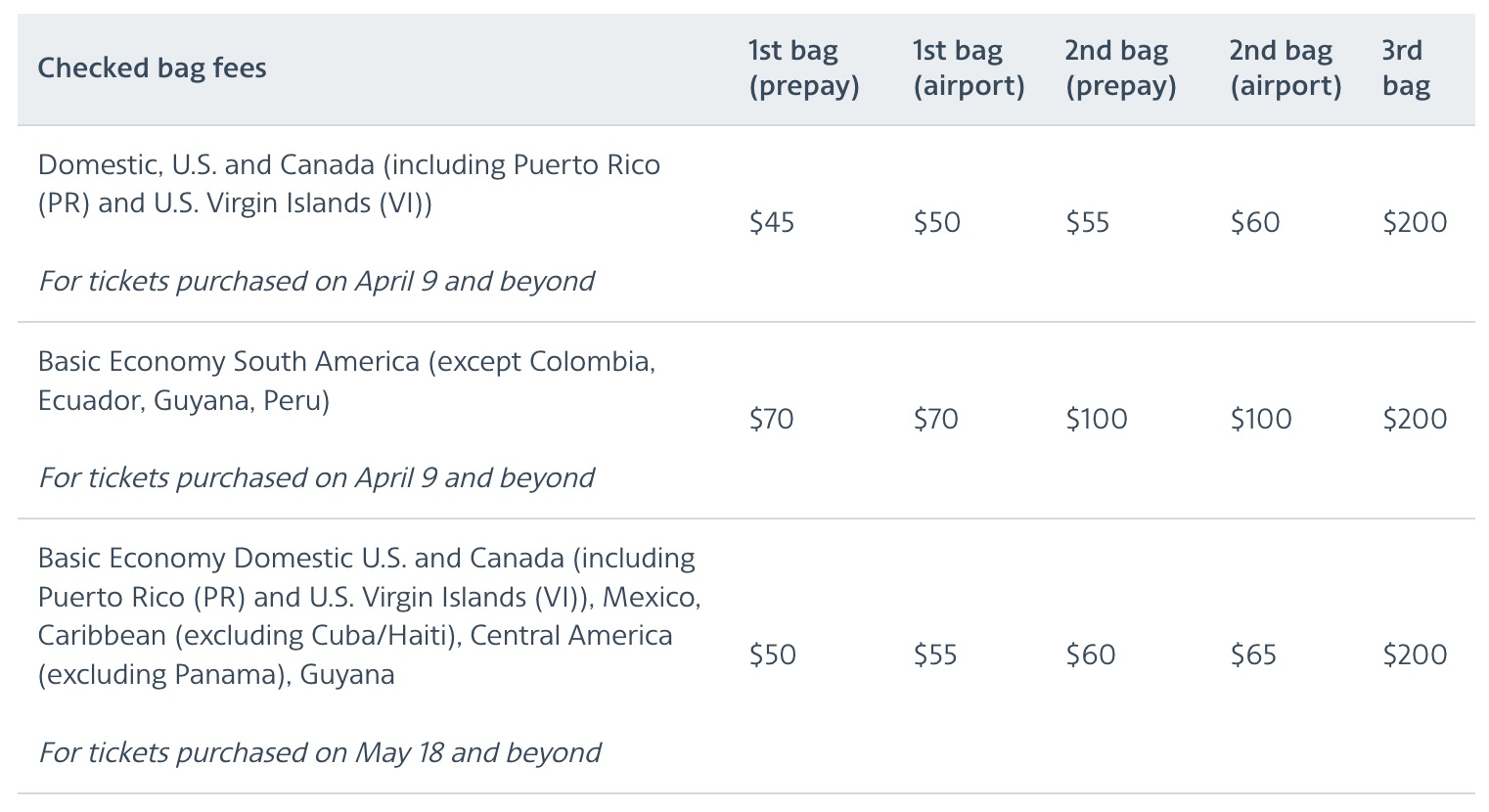
Effective for new tickets purchased on or after May 18, travelers booking an American Airlines basic economy fare will pay an additional $5 to check a bag. So that’s:
- $50 each way to check one bag – or $55 at the airport
- $60 for a second bag – or $65
- And effective immediately, you’ll pay $70 each way to check a bag down to much of South America, flying basic economy
- Those same, higher rates will apply to Colombia, Ecuador, Peru, and Guyana, effective May 18, too
As always, travelers with AAdvantage status can get free bags on American-operated flights, no matter which fare they buy. That’s true for co-branded AA cardholders with one key caveat: It only applies to domestic flights (and unofficially, shorter international routes).
On one hand, penalizing basic economy fares with higher bag fees sure beats stripping out carry-on bags from those cheaper fares – a policy American once had and that United still uses. On the other hand, the struggle to find open bin space is going to get much, much worse as a result.
With both American and the recently merged Alaska and Hawaiian joining the fold, now every major U.S. carrier has raised bag fees … in just over a week. Budget carriers like Spirit, Frontier, and Allegiant are likely charging more, too – ultra-low-cost carriers just use a different (unpredictable) system for bag fees, with rates that vary from route to route.
Jet fuel prices have doubled since the start of the war in Iran and the ensuing closure of the Strait of Hormuz, climbing from roughly $2.40 per gallon to nearly $5 – though recent positive news from the Middle East has brought average prices down to $4.16 as of Thursday morning, according to the Argus U.S. Jet Fuel Index. Fuel is one of airlines’ biggest expenses, second only to labor.
But while airlines have already raised ticket prices – with United saying some fares were up 15% to 20% and Delta’s CEO indicating higher fares would stick around through the spring and into summer – increasing fees is an even more effective lever for airlines to pull for a few reasons:
- Airlines have to pay a 7.5% excise tax on the fares they charge, but not on optional fees like baggage or seat assignments
- Those optional fees make airlines’ co-branded credit cards – their real profit engines these days – even more alluring to consumers as a way to escape extra fees
- The last two decades of airlines unbundling fares and charging fees have proven that even when fuel prices decline, elevated fees remain unchanged
While an extra $10 or $15 per bag may not seem like much, luggage fees are big business. U.S. airlines collected more than $7.2 billion (with a b) on bag fees alone in 2024, according to federal data. Even a small increase to fees will generate hundreds of millions of dollars in additional revenue for each airline.



What is really insane, is I booked a flight through American Airlines portal for one-way domestic travel. I am a card holder, normally no baggage fee. Because the flight was being operated by another carrier (i think American Eagle or Alaska, i can’t remember which) my one way baggage fee was $240. I thought that was a glitch, and called AA. No glitch. She said that fee was being imposed by the other carrier. But where does $240 even make sense at, on a OW flight with only 1 layover.
Fortunately I saw that fee and canceled within 24 hours. But booking on the portal, I’m no longer booing flights “operated by” unless I know i only need a carry on.