



If you've been sitting on a pile of Chase Ultimate Rewards points, earmarked for a Hyatt stay, don't sit on them much longer.
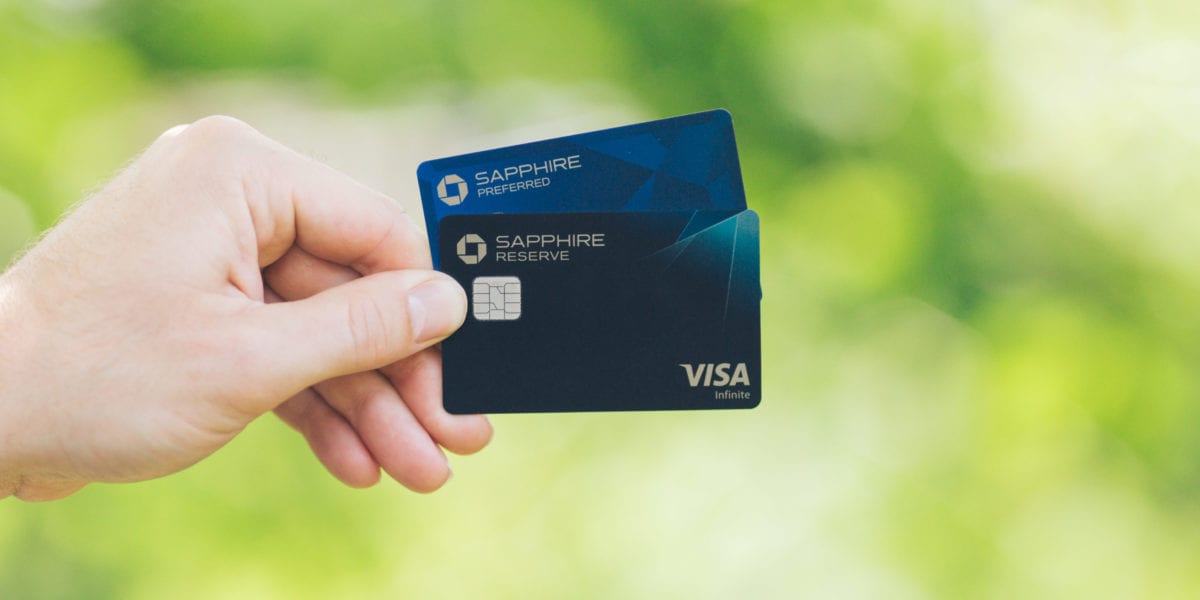
Come Oct. 1, 2026, travelers with the *chase sapphire preferred* will lose the ability to transfer points to World of Hyatt at the standard 1:1 ratio. After that, it's a 4:3 conversion – meaning you'll need 67,000 Ultimate Rewards points to end up with just 50,000 Hyatt points.
This change only impacts longtime Sapphire Preferred (and Ink Business Preferred) cardholders who opened their cards prior to June 15. If you just picked up the Sapphire Preferred sometime this summer, that 4:3 ratio is already in place.
For now, the bank is leaving the *chase sapphire reserve* and *Sapphire Reserve for Business* alone. Cardholders there keep the clean 1:1 transfer to Hyatt – 1,000 Chase points out, 1,000 Hyatt points in. The subtext here isn't too subtle: Chase wants Preferred cardholders eyeing Hyatt redemptions to upgrade to the $795-a-year Reserve. If you're a frequent-enough Hyatt guest that this better transfer ratio matters, it might be worth running the math on whether that upgrade pencils out for you.
Here's what's changing, who it affects, and what you should actually do about it before the clock runs out.
What's Changing (& When)
Chase first announced this cutback in June, buried inside an otherwise positive refresh of the Sapphire Preferred that added perks like a new credit of up to $120 it for Global Entry, TSA PreCheck®, or NEXUS and doubling the annual Chase Travel℠ hotel credit.
The timeline works like this:
- Anyone who applied for the Sapphire Preferred (or Ink Business Preferred) on or after June 15, 2026, already has the lesser 4:3 ratio.
- Existing cardholders – anyone who had the card before June 15 – got a grace period, keeping 1:1 transfers until Oct. 1, 2026.
- After Oct. 1, everyone with the Sapphire Preferred or Ink Preferred moves to 4:3, full stop.
That leaves legacy cardholders with just a couple of weeks to lock in the old ratio.
A Genuine Double-Whammy
The timing here is brutal, and not by coincidence.
Just weeks before Chase's announcement, Hyatt rolled out a new five-tier award chart, replacing its old off-peak, standard, and peak pricing system with far more room to raise prices at the top end. It's not full-blown dynamic pricing in the vein of Marriott and IHG … but it might as well be.
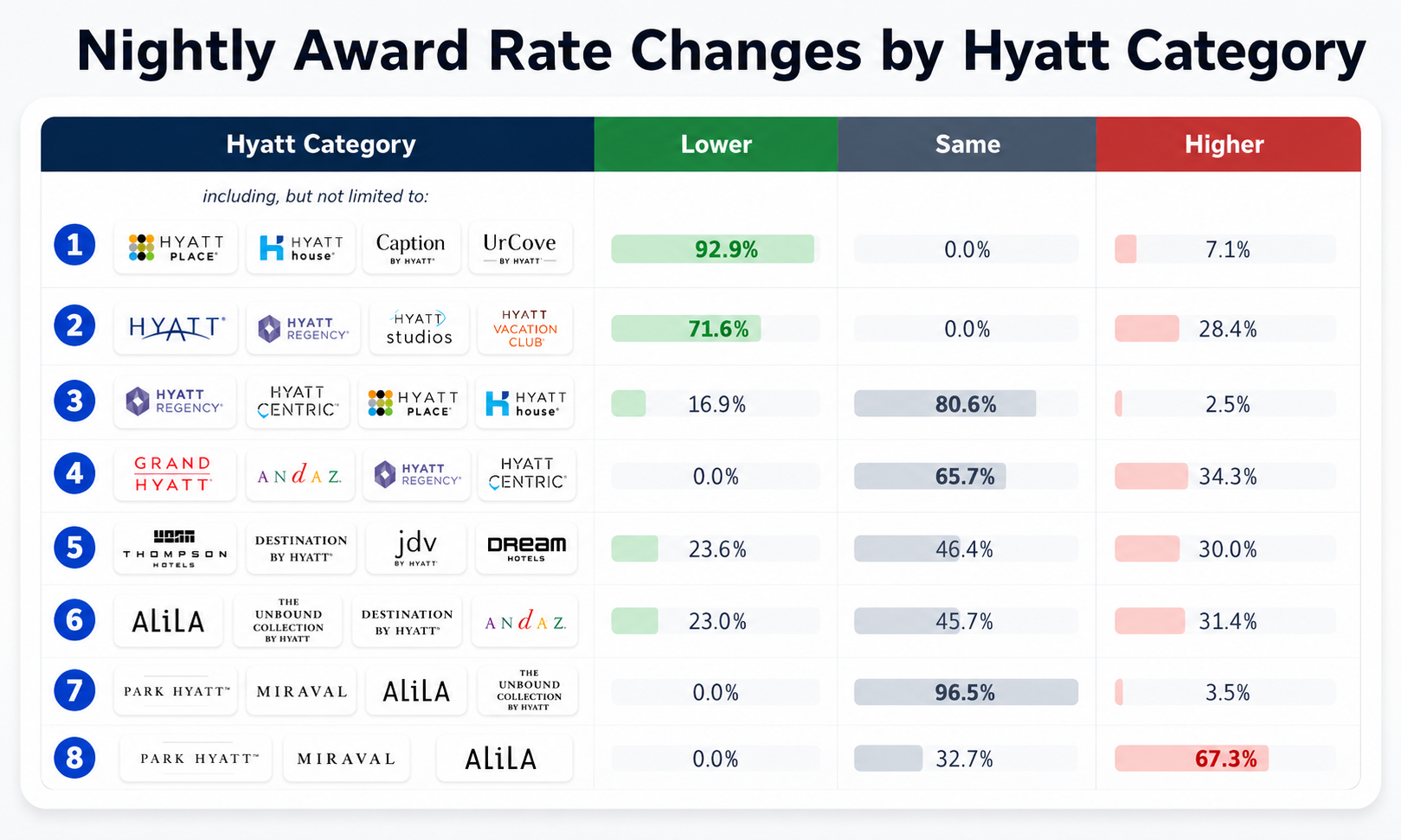
We ran the numbers on nearly 368,000 award nights across Hyatt's portfolio just after the change took effect, and the damage at the high end was significant:
- 67.3% of nights at Category 8 properties (think Park Hyatt, Alila) got more expensive – by an average of another 8,000 points per night.
- Standard-rate nights at top Category 8 hotels jumped from 40,000 to as much as 55,000 points – a 38% increase.
- Peak nights at those same hotels went from 45,000 points to as much as 75,000 – a whopping 67% jump.
- Not a single night at a Category 7 or 8 property – anywhere in the world – got cheaper.
With those two changes coinciding in the span of a few months – Hyatt's devaluation and Chase's decreased transfer ratio – it's a real one-two gut-punch for travelers with Chase's most popular card.
Here's a quick example to illustrate how bad this hurts: A Sapphire Preferred cardholder could previously use 45,000 Hyatt points (at most) to book a night at the Park Hyatt Tokyo – meaning 45,000 Chase points transferred to Hyatt at a 1:1 ratio. That same night could cost as much as 75,000 Hyatt points today … requiring 100,000 Chase points once you factor in the 4:3 hit.
That's more than double. In a matter of months!
The Case for a Speculative Transfer
Normally, we don't recommend speculative transfers – moving points to a hotel or airline partner before you have a booking in mind. Once Chase points become Hyatt points, they're stuck there. You can't transfer them back to the more flexible Ultimate Rewards currency.
But this is one of those rare situations where it might make sense, if:
- You regularly stay at Hyatt properties, or …
- … you've got a few solid, realistic use cases already in mind – and have researched their current rates – and …
- … you're flush enough with Chase points that locking some away in Hyatt doesn't cramp your other travel plans.
If none of that describes you, don't transfer just because this deadline is looming. A speculative transfer only pays off if you actually have a use for the points on the other end. With Chase's slew of airline partners, having those points available to book a hot flight deal could prove far more valuable than whatever you might, theoretically, get out of Hyatt.
Personally, I'm sitting on a pretty healthy balance of Ultimate Rewards at the moment and plan to make some sort of speculative transfer before this change goes into effect. Just how big it will be still needs to be determined. In my case, I think it's worth the gamble – but that doesn't mean the same will be true for you.
Even if you're not in a position where it makes sense to speculatively transfer a boatload of points, now's the time to dig into your next 12 months of travel plans.
Is there a Hyatt that fits neatly into an upcoming trip to Chicago, San Diego, New York, London, Tokyo, or wherever else? Dig into the rates and do some quick math on whether it'd be wise to transfer and book before this Oct. 1 deadline.
Where the Value Still Holds Up
Despite the two-front devaluation, Hyatt didn't get worse everywhere. Our post-changeover analysis found the low end of the chart actually improved:
- 93% of Category 1 nights priced out lower than before.
- Nearly 72% of Category 2 nights got cheaper, too.
- Category 5 and 6 properties were a mixed bag, but nearly a quarter of available nights in those tiers dropped in price.
If your Hyatt stays lean more Hyatt Place, Hyatt House, Hyatt Regency, or Hyatt Centric than Park Hyatts and Andaz resorts, the award chart change stings a lot less – and locking in 1:1 transfers before Oct. 1 still gets you real value at those properties.
For example, the Hyatt Place Bloomington/Normal in central Illinois now costs 6,000 points per night, down from the previous 6,500-point rate.
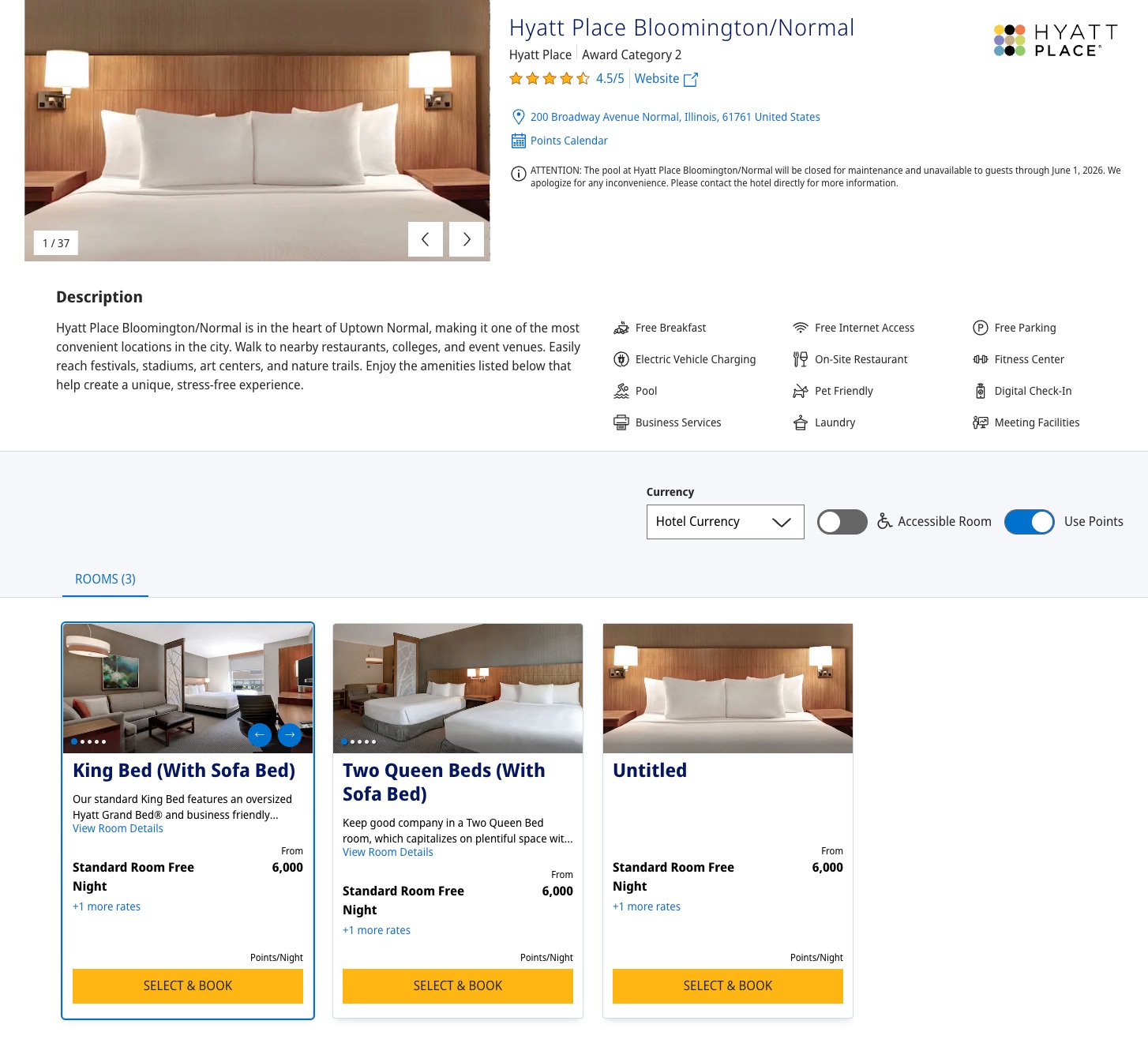
Transferring Chase points to Hyatt at the current 1:1 ratio for stays like that could make a lot of sense, as the same nights will soon cost you 8,000 points. Don't get me wrong, a 2,000-point difference probably isn't enough to make a speculative transfer worthwhile, but if you start to multiply that by five or 10 nights … things get interesting.
Just keep in mind, Chase isn't the only game in town: Bilt points also transfer to Hyatt at 1:1, with no change in sight – a fact that becomes more relevant with every bank that cuts transfer ratios.
If you've got a big balance of Bilt points or a way to earn them in bunches (including through rent or mortgage payments), a speculative transfer from Chase probably doesn't make sense. Bilt remains a clean way to top off your Hyatt account regardless of Chase's pending move.
Bottom Line
Longtime Chase Sapphire Preferred (and Ink Business Preferred) cardholders have until Oct. 1 to transfer points to Hyatt at 1:1. After that, it's a 4:3 ratio for everyone except Sapphire Reserve and Reserve for Business cardholders.
Combined with Hyatt's new five-tier award chart, redemptions are about to become more expensive for many travelers. If you've got a Hyatt trip in mind and Chase points sitting in your account, the clock is ticking.