



You've got questions about the *chase sapphire preferred*? We've got answers!
We've spilled plenty of ink on the Sapphire Preferred over the years, and for good reason. For more than a decade, the Sapphire Preferred has been one of the most popular travel credit cards on the market. It's undoubtedly our favorite card for beginners, and recently got even better (for most travelers) with new credits, perks, and a better return on your spending – all with the same $95 annual fee.
Plus, you can currently earn 75,000 bonus points after $5,000 in purchases in your first three months from account opening.
Beyond that welcome bonus, there are great benefits like excellent travel and rental car insurance, an annual $100 Chase Travel℠ hotel credit, a year of complimentary Apple TV (activate by Dec. 31, 2026), and much more. Throw in its reasonable annual fee of $95, and it's easy to see why this card is a mainstay in countless travelers' wallets.
Still wondering what the Chase Sapphire Preferred is all about? Here's a one-stop shop for answers to all your burning questions.
Learn more about the *chase sapphire preferred*
- Just How Good is This Bonus?
- Are You Eligible?
- What Credit Score Do I Need?
- How Can I Use Chase Ultimate Rewards Points?
- How Does the Hotel Credit Work?
- How Do You Get Free Apple TV?
- What Kind of Rental Car Insurance Do I Get?
- What About Other Travel Insurance?
- What Happens if My Luggage Gets Lost?
- Should I Get the Chase Sapphire Reserve Instead?
Just How Good is This Bonus?
Really, really good: bonus_miles_full
Chase points are, without a doubt, among the most valuable you could earn from any bank. At a minimum, those points are worth $750 toward travel when booking through the Chase Travel℠ portal – if not much, much more by utilizing Chase transfer partners.
Are You Eligible?
This is the 75,000-point question.
Last year, the bank softened some of its notoriously strict eligibility requirements – most notably, allowing travelers to open and hold both the Sapphire Preferred and the *chase sapphire reserve* simultaneously. This is especially great news for anyone who's picked up a Sapphire Reserve in recent years (or even months), as it clears the way for earning another bonus on the cheaper Sapphire Preferred this time around.
But in some ways, Chase actually made things harder than ever by shutting out previous Sapphire Preferred cardholders entirely. In place of its old 48-month rule – which gave current cardholders a pathway to get a big bonus again if it had been four-plus years since they last earned one – the terms now include this: “The new cardmember bonus may not be available to you if you previously held this card or received a new cardmember bonus for this card.”
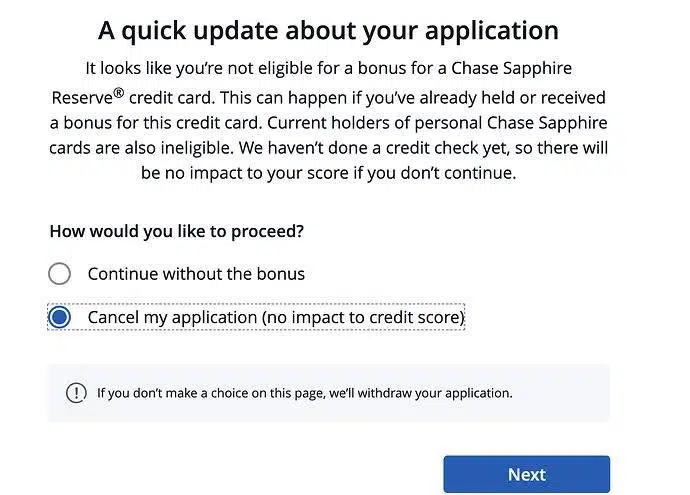
At the very least, a new pop-up notification during the application process has eliminated much of the guesswork. You can now back out of an application – without triggering a credit pull – if Chase decides you're not eligible for the bonus … so at least there's little risk in trying for it.
There's one more hitch to keep in mind that could make you ineligible to open a Chase Sapphire Preferred: The Chase 5/24 rule.
The Chase 5/24 rule is a restriction rolled out years ago to limit applicants from opening credit cards solely to earn bonus rewards. Here’s what it boils down to:
- If you have opened five or more credit cards in the past 24 months from any bank (not just Chase), you will not be approved for Chase credit cards, regardless of your credit score or history with Chase Bank.
- The rule doesn't count credit inquiries, but rather card products you have applied for and been approved for. That also means mortgages and other lines of credit don't count.
So if you've opened five or more new credit cards in the past 24 months, you will not be approved for any Chase credit cards, including the Sapphire Preferred Card with this big bonus. Chase isn’t just looking at your history with Chase cards to make this determination – every bank is subject.
Read more: How to Track Your Chase 5/24 Status (& Why You Should)
What Credit Score Do I Need?
Chase is known as one of the stingiest banks for new card approvals, so it's important to make sure that your credit score is up to snuff before applying.
From our own experience, reader accounts, and historical data from creditcards.com, anyone with a credit score below 700 will generally have a harder time getting approved for the Chase Sapphire Preferred Card.
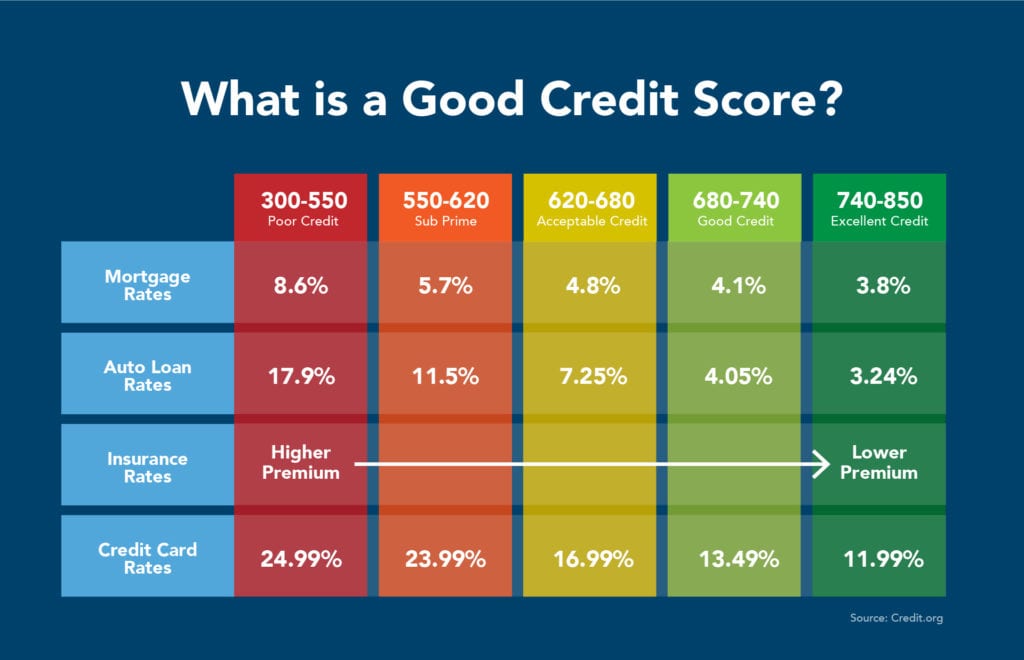
That said, the minimum credit score needed to apply is not set in stone. There are certainly exceptions – especially if you have a history with Chase. But your best bet for getting the Chase Sapphire Preferred is likely by having a credit score of 700 or higher. If your credit score isn't at least 680, it's unlikely you'll be approved.
Read more: What Credit Score Do You Need for the Chase Sapphire Preferred?
How Can I Use Chase Ultimate Rewards Points?
Chase Ultimate Rewards are one of the most valuable currencies of all points and miles, so it should come as no surprise that 75,000 points can get you quite far (literally).
One of the easiest (and our favorite) ways to use any frequent flyer points is booking the cheap domestic or international flight deals you find on Google Flights or with a Thrifty Traveler Premium subscription.
If you're looking to squeeze even more value out of your Ultimate Rewards, consider transferring them to one of Chase's 14 airline and hotel transfer partners. Using your Chase points to book award travel with a transfer partner requires some more legwork, but it can definitely be worth it if you're looking to get even more out of your Chase points.
Here's a fun example: Chase points transfer to Iberia on a 1:1 basis. That means 32,000 Chase points get you 32,000 Iberia Avios, and that's enough to fly from Boston (BOS), New York City-JFK (JFK), Washington, D.C.-Dulles (IAD), or Chicago-O'Hare to Madrid (Madrid) roundtrip in economy.
Traveling solo … or feeling selfish? Why not use those points to fly business class to Spain instead? You can do it for as low as just 40,500 miles each way, or 81,000 miles roundtrip! That's less than most airlines charge for a one-way business class ticket!
And with Iberia business class, you're in for a treat. The seats are plenty spacious and recline all the way into a comfortable bed, and the food is tasty.

But if you time it right, you can multiply your points by taking advantage of a transfer bonus. Chase regularly offers a big bonus on transfers to Iberia, as well as British Airways and Aer Lingus. With a 20% bonus, for example, you'd have more than enough points for three one-way flights … in business class.
Considering these flights typically cost $4,000 or more when paying cash, it's a phenomenal way to use Chase points.
Get some additional inspiration on how to use a big stash of Chase Ultimate Rewards!
How Does the Hotel Credit Work?
It's a sneakily good benefit for holding the Chase Sapphire Preferred. And it's easy to put to use.
All you need to do is use your Sapphire Preferred Card to book and pay for a hotel stay through Chase Travel℠ , and you will receive an automatic statement credit for up to $100 each year. That's double the previous sum Preferred cardholders got before a summer 2026 refresh.
This credit follows your account member year instead of the calendar year. So if you opened your Chase Sapphire Preferred Card in April, you'd have one $100 hotel credit to use right now, then another after renewing your account in April 2026.
Just be warned that since Chase Travel℠ is classified as an online travel agency, the hotel will consider this a third-party reservation. For that reason, you might want to avoid using this at hotels in a large chain like Marriott, Hyatt, Hilton, IHG, etc. – where you might be forgoing elite benefits or the ability to earn points by booking through Chase.
Read more: Don't Forget to Use This Benefit on Your Chase Sapphire Preferred!
How Do You Get Free Apple TV?
Chase's Sapphire Preferred now comes with a complimentary year of Apple TV – but you have to actually activate it. Head to your Chase account and turn on the benefit by December 31, 2026. From there, you're covered for at least 12 months, starting the day you activate.
Already paying for Apple TV directly through Apple? Your paid subscription automatically pauses once the complimentary one kicks in – no need to cancel anything yourself. Once your free 12 months end, your paid subscription just resumes at Apple's then-current price.
Got Apple One instead? You won't get the free subscription – you'll get a $7.50 monthly discount on your existing Apple One bill, starting the next billing cycle after activation (as long as you use the same Apple Account for both). Just know: it's one benefit per Apple Account, so there's no stacking or double-dipping across cards.
This benefit alone is worth $156 if you'd otherwise pay for Apple TV – but only if you remember to activate it before the deadline.
What Kind of Rental Car Insurance Do I Get?
Both the Chase Sapphire Preferred and Reserve come with primary rental car coverage. And that means if something happens to your rental, you can skip your own insurance and go straight to Chase for help.
In order to take advantage of this coverage, you need to charge your rental to your Sapphire Preferred card and decline the collision damage waiver that the car rental company tries to sell you. This coverage provides reimbursement for damage due to collision or theft on rental cars in both the U.S. and when traveling internationally. If you get into an accident, it will cover the costs of any damage up to $60,000.
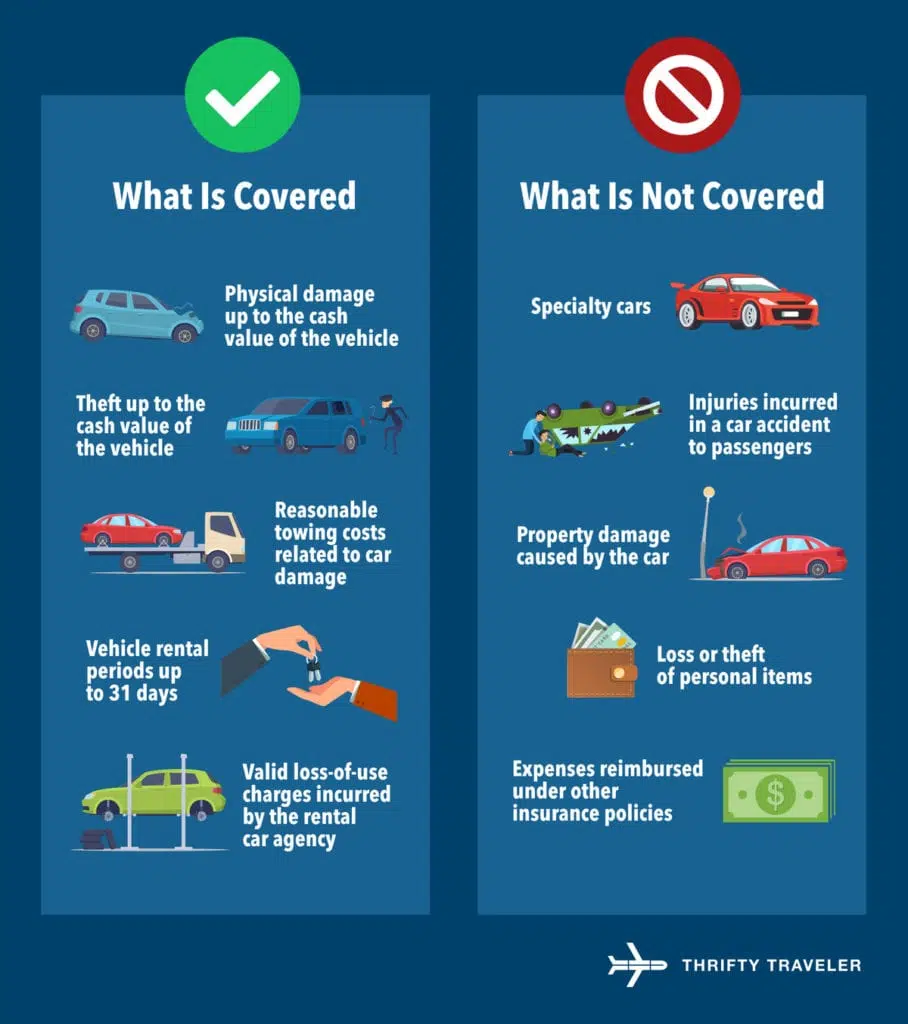
Just note that this is not liability insurance. It will not cover medical bills, damage to another vehicle, or damage to property. Still, it's some of the best car rental coverage you can get through a credit card. And it means you can skip the extra cost of adding a policy to your next rental.
Additional reading: All About the Chase Sapphire Rental Car Insurance Benefit
What About Other Travel Insurance?
Primary car rental coverage isn't the only way the Chase Sapphire Preferred will protect you if your travels go awry.
This card also provides top-of-the-line travel protections in the event your trip is cut short, canceled, or delayed before it even gets going. There are certainly other cards on the market that offer similar coverage – some with higher levels of protection – but you won't find a more affordable option than the Sapphire Preferred.
Chase's trip cancellation and interruption insurance covers you in the event your trip is canceled or cut short by sickness, severe weather, or other covered situations. If you encounter one of these situations, you can be reimbursed up to $10,000 per person and $20,000 per trip for your pre-paid, non-refundable travel expenses.
Chase lists the following examples as situations that would be covered, while noting it isn't an exhaustive list:
- Accidental bodily injury, loss of life, or sickness experienced by the cardholder, a traveling companion, an immediate family member of the cardholder, or a traveling companion.
- Severe weather that prevents the start or continuation of a covered trip.
- Terrorist action or hijacking.
- Jury duty or a court subpoena that cannot be postponed or waived.
What if you encounter a delay instead of an outright cancellation? Good news! If you booked your trip with your Sapphire Preferred Card and your common carrier (airline, bus, cruise ship, or train) is delayed for a covered reason for 12 hours or more, or overnight, you can receive reimbursement for expenses like meals, lodging, toiletries, and medication up to $500 per ticket per trip.
This coverage is only applicable for a trip away from the cardholder's city of residence – and only on trips under 365 days.
Read more: A Firsthand Experience With Chase's Trip Delay Insurance
What Happens if My Luggage Gets Lost?
Airlines have become notorious for losing and misplacing luggage. So much so that Apple Airtags became 2022's most must-have travel accessory. This is just one of the many reasons we recommend traveling with a carry-on only, whenever possible.
So what happens if you have to check a bag and it doesn't make it to the conveyor belt as planned? Luckily, Chase has you covered!
If you pay for your flight with your Chase Sapphire Preferred Card (or Chase Ultimate Rewards points from your card), you can get reimbursed for essential items like toiletries and clothing when your baggage is delayed or misdirected by more than six hours. This benefit only applies when traveling on a common carrier, such as an airline, bus, cruise ship or train, while on a covered trip. Thankfully, that covers mostly everyone, unless you're flying private or on a charter, in which case you wouldn't be eligible to receive compensation.
The cardholder, the cardholder's spouse or domestic partner, and any immediate family will be covered for up to $100 per day for a maximum of five days. Using this benefit, even once, would cover several years' worth of $95 annual fees making it a massive return on a low annual fee card.
Should I Get the Chase Sapphire Reserve Instead?
No. At least most people probably shouldn't.
If you're looking for travel benefits like airport lounge access or rental car elite status, you're probably better off looking at the *venture x* instead. At $395 per year, it's cheaper than the Chase Sapphire Reserve with nearly identical benefits.
In fact, you could even get both the Venture X Card and the Chase Sapphire Preferred and still pay less out of pocket in annual fees, at $490 for the two cards versus $795 a year for the Reserve. This would allow you to earn not one but two sign-up bonuses, get access to a different set of transfer partners, and ensure that you're earning no less than 2x points for all your spending.
Read more: The Perfect Two-Card Combo: Chase Sapphire Preferred & Capital One Venture X
Bottom Line
The Chase Sapphire Preferred is one of the best travel credit cards on the market right now. This FAQ should provide you with answers and additional resources to some of the questions that we're getting most frequently.
Learn more about the *chase sapphire preferred*