



More than a year after it first bubbled up, Uber’s “price-gouging” practices on airport drop-offs are making the rounds on the internet and social media again. But there’s an easy way to save.
Uber rides to the airport are almost always pricier than your typical trip, but travelers can see drastically different fares depending upon – even at the same terminal. It first cropped up last year on Reddit, where a user heading for Terminal 4 at New York City (JFK) noticed that selecting Virgin Atlantic instead of Delta brought the fare from $81 down to $53. Same trip. Same terminal. Same car. Nearly $30 in extra charges … just for selecting a different airline in the Uber app.
Our pal @traveldaddydave on Instagram flagged an even more egregious example this weekend: Nearly $50 for an Uber ride to Atlanta (ATL) with a drop-off for Delta … or under $18 by selecting American instead. That’s almost triple the cost!
It’s not an isolated case. We discussed this pricing scheme on our podcast last summer, and it’s roaring back into the public consciousness.
What’s Going On Here?
While this started with a Reddit post about Delta and Virgin Atlantic at JFK, the underlying issue isn’t specific to any single airline. It’s about how Uber codes each airline as a unique location in its system — and how that interacts with Uber’s dynamic pricing.
In theory, this could happen with any airline at any airport where multiple carriers share a terminal. Whether it does depends on how Uber has mapped those drop off zones and how demand is measured at the moment you book.
While Uber’s official help documentation doesn’t explicitly state that selecting your specific airline influences ride pricing, it does emphasize the importance of identifying your airline for accurate drop-off (and pickup) locations.
As noted in the company’s airport trip guidance, Uber advises drivers that a rider’s airline helps them locate the right departure area. However, this guidance doesn’t address pricing directly – it’s more about navigation and logistics.
Our testing suggests that Uber treats each airline as a distinct “location” in its system, even when they share the same terminal. That means differences in demand, driver supply, or surge conditions at those coded locations may influence fare prices, and our firsthand experiments (and the Reddit example) suggest it’s a real, but sometimes subtle, difference.
Our Own Testing
We couldn’t resist digging deeper.
At JFK Terminal 4 — the same spot from the original viral Reddit post — we confirmed the fare difference between Delta and Virgin Atlantic for identical rides. While the exact gap will vary by time of day, traffic, and demand, we saw similar discrepancies of $15 to $25.
From there, we tested the theory at other airports:
At our home airport of Minneapolis-St. Paul (MSP), the fare differences were smaller, but still present. Selecting Delta vs. American Airlines for the same drop-off spot (Terminal 1) showed a difference of a few dollars on multiple tests.
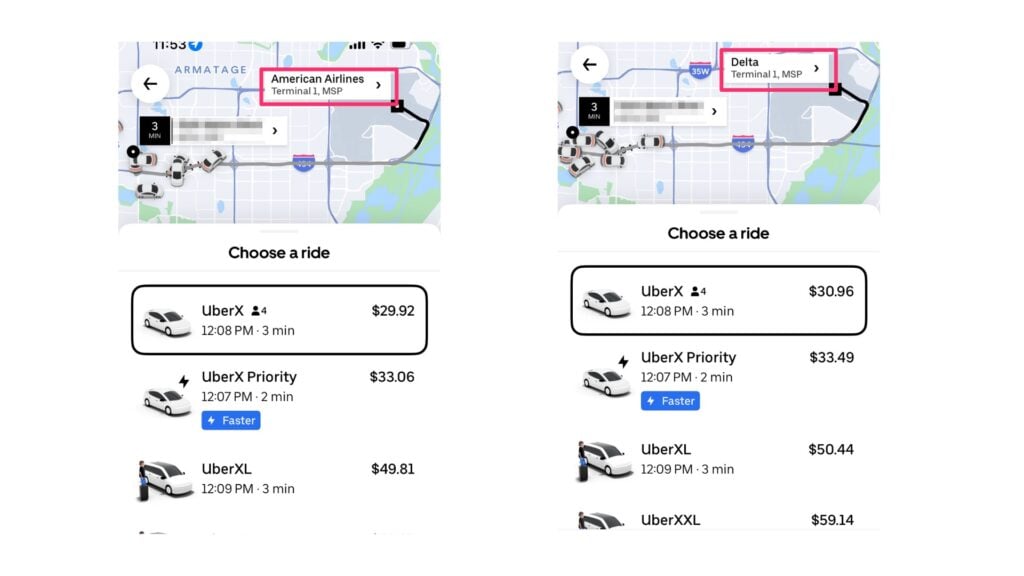
We checked a handful of other major airports and found mixed results; some showed no difference at all, others varied by just a few dollars. In Atlanta, there was a difference of more than $30!
We also ran the same tests with Lyft and couldn’t seem to recreate the issue, though it’s always worth checking. That’s true of any ride to the airport: Check both platforms for a better price.
Most travelers assume that choosing an airline in the Uber app is purely about logistics. It’s reasonable to expect the price to stay the same if the location you are getting dropped off at isn’t any different.
These findings suggests otherwise.
How to Protect Yourself
The good news? Once you know it’s a thing, this is an easy one to avoid.
- Always check at least two airline options in the Uber app before confirming your ride.
- Pick an airline that uses the same terminal as your flight departs from. Don’t choose one from a totally different terminal – unless, of course, you’re willing to navigate to the right terminal on your own.
- Compare with Lyft, even if you usually default to Uber. In our testing, Lyft’s prices stayed consistent regardless of airline selection.
- Don’t assume the difference will be small. At New York City JFK, the gap was $20+ for the same ride. That’s enough to cover coffee for two before your flight.
In theory, this could happen with any airline pairing at any airport where multiple carriers share a terminal. Whether it does depends on how Uber has mapped those pickup zones and how demand looks at the moment you book.
Bottom Line
If you’re hailing an Uber to or from the airport, the airline you select in the app could change your fare, even if you’re getting dropped off (or picked up) at the same terminal.
It might be just a few dollars … or it could be $20 or more. Check different airline options in the app, compare with Lyft, and don’t assume the price you’re shown is the only one available for your trip.
In today’s world of dynamic pricing, even minor details can save you big money.



Great info, thanks Nick!
I actually discovered this last week, but it was a restaurant. Literally 1 restaurant on the main floor, and another one the rooftop. $3.50 price difference. I even double checked both again right after another to see if the price really had dropped, and no, the locations still gave different prices…and the rooftop was cheaper!
It also matters of you choose personal or business trip, just FYI.
Which is cheaper?