


Don't say we didn't warn you: Flight prices are likely to go up … soon.
United Airlines CEO Scott Kirby said rising jet fuel prices could quickly lead to higher ticket prices – one of the first public warnings from a major airline executive that travelers may soon feel the impact of the escalating conflict in the Middle East.
Speaking Thursday at an event at Harvard University, Kirby said higher fuel costs will have a “meaningful” impact on United’s financial results this quarter, according to reporting from CNBC. When asked when those rising costs might start showing up in airfare, Kirby said it will “probably start quick.”
Here’s what might be ahead for flight prices – and what travelers should do to get ahead of the curve.
Want more travel news, insights, and analysis? Sign up for our free Extra Mile newsletter and get it in your inbox every weekday!
Surging Jet Fuel Prices
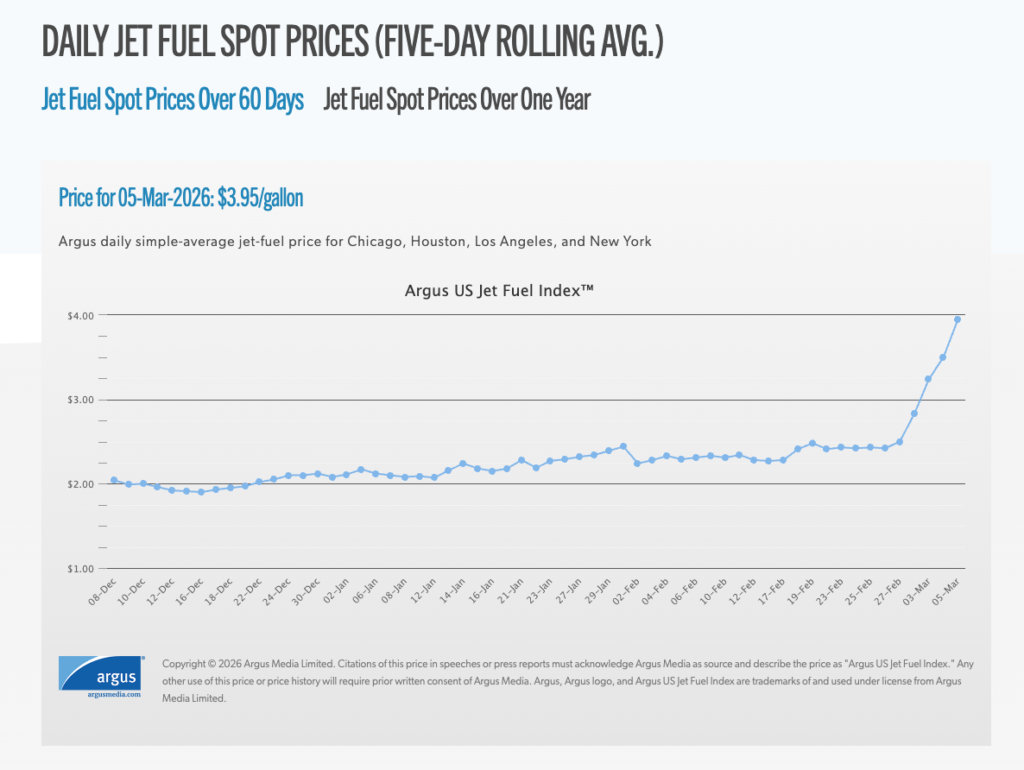
Jet fuel prices have jumped sharply in recent days as tensions escalate in the Middle East and oil shipments face disruptions near the Strait of Hormuz, one of the world’s most critical shipping routes.
According to the Argus U.S. Jet Fuel Index, jet fuel prices reached an average of $3.95 per gallon this week. Prices have surged roughly 58% in just the past week since the U.S. and Israel attacked Iran, according to industry reporting.
Fuel is one of airlines’ biggest expenses, second only to labor. Even a small uptick in jet fuel prices can cost airlines billions of dollars a year – the kind of cost that airlines are eager to pass onto their customers. And the easiest way to do that is to raise fares.
“If it continues, we’ll feel it in Q2 also,” Kirby said.
But there's much, much more to airfare than just fuel costs.
Higher Airfare Isn’t Guaranteed
Higher costs don't always equal higher fares. If that were true, then nonstop flights would always be cheaper than a one- or two-stop trip … and that's rarely the case.
Ultimately, fuel costs are a small driver of what moves airfare up and down. It's more about supply and demand and especially competition between carriers. That landscape is a mixed bag for the future of flight prices.
Other travel industry experts say that flight prices are already high, which makes it harder for airlines to pass additional costs onto travelers in the form of fare increases.
“Airfares are already relatively high, which could make it more difficult for airlines to pass on additional costs,” S&P Global analyst Rachel Gerrish told Barron’s.
Fares rose 6% month-over-month in January and were 2.2% higher than a year earlier, according to recent Consumer Price Index data. Ultimately, how much airfare rises may depend on whether strong travel demand continues, giving airlines the confidence to pass rising fuel costs on to passengers.
Then again, travel demand is high, too. And despite the uncertainty in the Middle East, that isn't changing. Kirby said United’s booked revenue is up roughly 20% from a year ago, adding that demand “has not taken even a tiny step back.”
With widespread flight disruptions and airspace closures across parts of the Middle East, travelers who normally connect through major hubs like Dubai (DXB) or Doha (DOH) are increasingly booking alternate routes.
Kirby said United has seen a surge in bookings from Australia and New Zealand to Europe – routes that typically rely on Middle Eastern hubs: “Each day this week, we have booked over 1,000 people from Australia and New Zealand to Europe. Last year, we booked less than one a day.”
What Travelers Can Do Right Now
If higher fuel costs eventually push airfare up, travelers planning trips later this year may want to consider locking in flights sooner rather than later – especially for summer travel.
Booking flights with flexible change policies can give you the best of both worlds: locking in today’s prices while keeping the option to adjust your plans later if cheaper fares appear.
This may also be a particularly good time to redeem points and miles. Airlines that don’t currently add fuel surcharges to award tickets aren’t likely to introduce them overnight – meaning award rates for airlines that currently publish an award chart could remain a relative sweet spot even if cash fares rise.
On the flip side, travelers booking award tickets may want to avoid programs that already charge hefty fuel surcharges (we're looking at you, British Airways). As fuel costs rise, those airlines will likely adjust their fees to reflect higher costs in the months ahead.
Bottom Line
United CEO Scott Kirby warned that rising jet fuel prices, driven by the escalating conflict in the Middle East, could soon push airfare prices higher. Fuel prices have surged dramatically in the past week, and airlines now have less protection from price spikes than they once did.
If those prices remain elevated, travelers could start seeing higher ticket prices in the coming weeks or months ahead – making it worth locking in flexible travel plans sooner rather than later.