



You’ve picked your flights. You’re ready to pay. And then, before you can even enter your credit card number, the airline's add-on travel insurance upsell arrives.
“Protect your trip. Highly recommended. 100,817 travelers added this last week.”
It looks helpful and feels important. And the way airlines present it – especially with friendly green checkmarks and warnings about delays or missed connections – makes it seem like something every traveler should buy. But should you? And what does this kind of insurance actually cover?
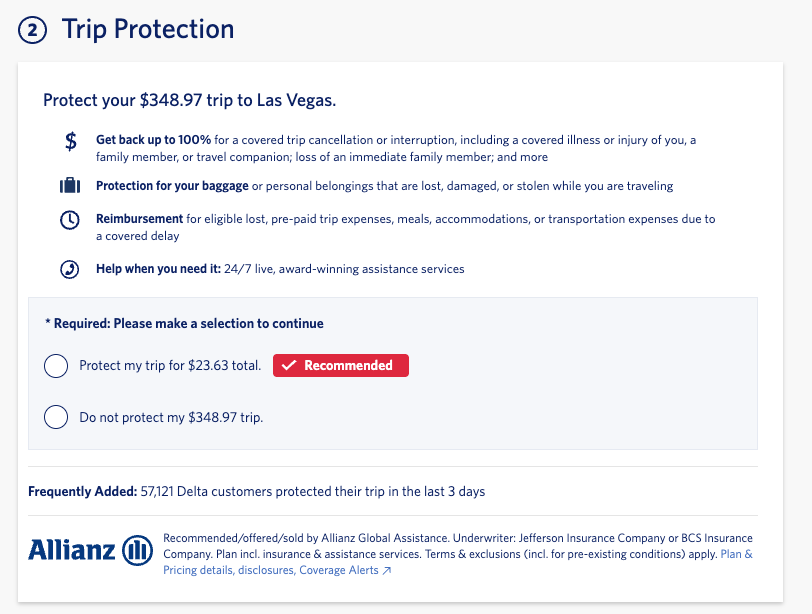
These policies aren’t new, but the way airlines push them today feels different. In an era when almost every major U.S. airline allows you to cancel a main cabin fare for a voucher toward future travel – no insurance required – the hard sell can feel downright slimy. Many travelers who haven’t kept up with the post-pandemic rule changes are paying extra for coverage they (probably) don’t need … or won’t benefit from when things go wrong.
We dug through the fine print for the optional insurance policies sold by Delta, United, and American. Here’s what we found.
The Promise vs. the Reality
On the checkout screen, these plans look simple: pay a small fee – often $20 to $40 – to “protect your trip.” Each airline frames it slightly differently, but the promise is always the same: peace of mind. What you’re actually buying is something much narrower. And despite how airlines present these plans, they're not a flexible ‘cancel anytime' safety net.
These policies do not insure your whole trip. They do not protect you from most airline-caused disruptions. And they certainly do not let you cancel for any reason. Instead, they cover just one thing: the airfare you’re purchasing at checkout, and only in a short list of very specific situations.
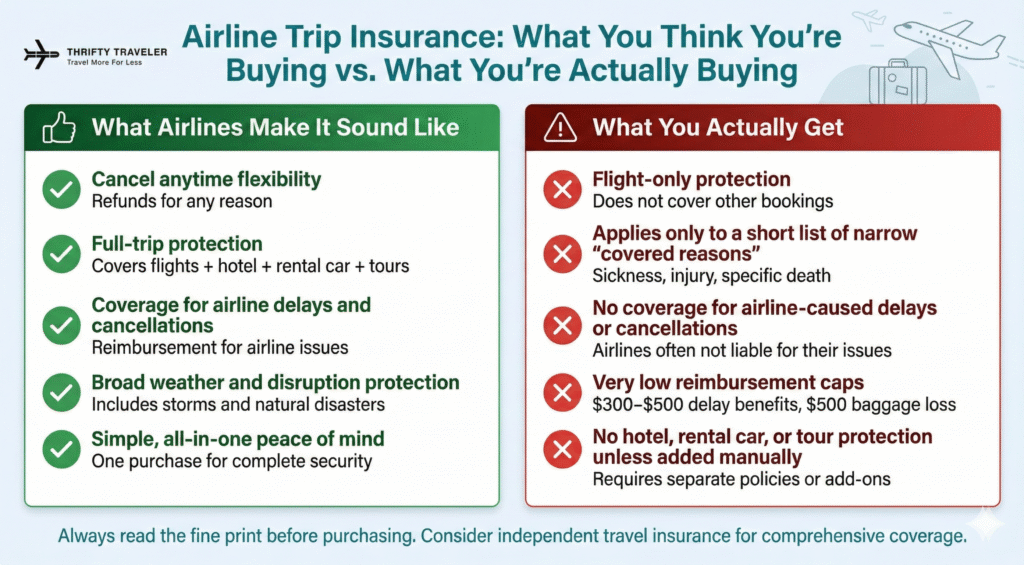
For many travelers, the gap between the marketing language and the reality can be an unfortunate shock.
Delta & American: Same Insurer, Same Fine Print
Delta and American both use Allianz Global Assistance, and their policies are nearly identical, even down to the legal disclaimers.
The coverage sounds broad: reimbursements for cancellations, delays, lost bags, and more. But dig just one layer deeper and everything hinges on the same phrase: “covered reasons.”
Covered reasons include things like a verified illness or injury, the death of a family member, a house fire, or certain severe weather events. While these are all legitimate scenarios, they’re extremely narrow. This is where many travelers get misled: the scenarios airlines highlight in their checkout pitch are often the exact ones excluded in the fine print.
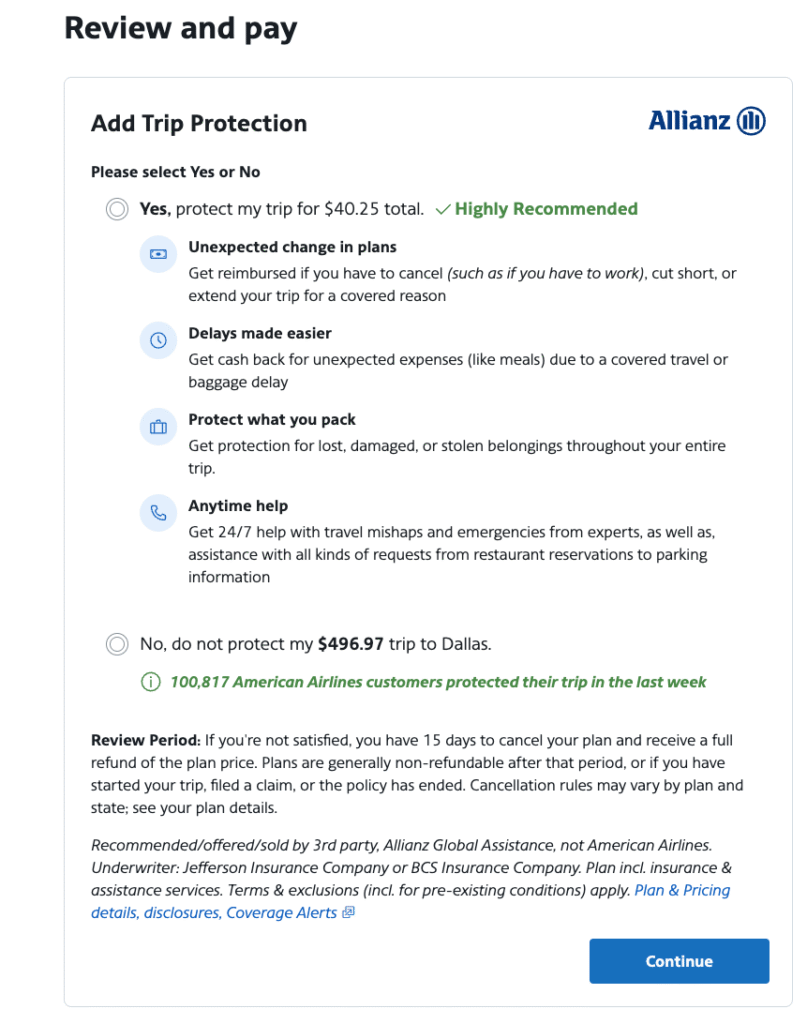
The much longer list of what isn’t covered includes some of the most common reasons travelers want insurance in the first place. Change of plans? Not covered. Work conflict? Not covered. Fear of traveling or a shift in government advisories? Not covered. Even most airline-caused cancellations and delays don’t qualify.
That’s one of the biggest misconceptions: this insurance does not protect you from the airline’s own operational issues. Mechanical problem? Crew shortage? ATC ground stop? A wave of cancellations triggered by a government shutdown? Allianz publishes specific “coverage alerts” saying these events usually don’t qualify.
Yet airlines routinely market this insurance using examples of the very events the policy won’t cover.
United: A Different Insurer, Same Story
United sells a plan through Travel Guard (AIG), but the end result is strikingly similar.
Like Delta and American, the advertised benefits – reimbursement for cancellations, delays, missed connections, and more – only apply if your situation meets Travel Guard’s strict definition of a covered reason. The FAQ outlines numerous examples of what isn’t covered, including fear of travel, changing your mind, being sick without consulting a doctor, airline-caused cancellations, and airline-caused misconnects, among others.
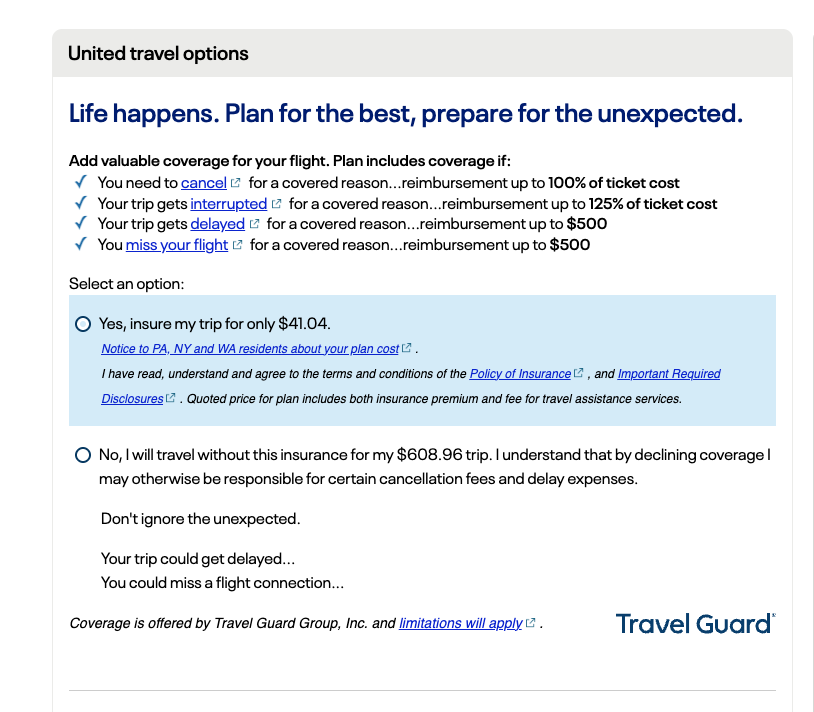
Reimbursement caps are low. Documentation requirements are strict. And the policy covers only your United airfare unless you manually add other components after purchase – something few travelers ever do.
The Fine Print That Really Matters
There’s one clause tucked into every airline plan: “Trip cost” means the travel expenses you booked on the airline’s website at the time you purchased insurance.” That’s it.
Unless you later modify the plan and pay more, you’re only insuring your flight – not your hotel, rental car, Airbnb, cruise, tour, or anything else you booked separately. Many travelers don’t realize this and assume they’re protecting their whole trip.
Other benefits are equally limited and leave many travelers who end up filing claims disappointed.
- Baggage loss coverage typically caps at just $500 – far below what airlines already owe you under federal law for lost bags on domestic flights.
- Trip delay benefits kick in only after six hours or more and usually cap out between $300 and $500 total – not per person.
- Baggage delay benefits require 24 hours or more of delay before reimbursement kicks in.
Use a Travel Credit Card Instead
Before you pay extra for the insurance your airline is offering, consider the credit cards you already have. Many travel rewards cards include built-in protections that are both more generous and easier to use than the policies sold at checkout.
You don’t need to add anything on. You don’t need to click “yes.” You just need to pay for your trip with the card.
These protections aren’t as comprehensive as a standalone travel insurance policy, but for standard flight disruptions, they are almost always more useful than the airline's own add-on plan. And critically, they often protect your entire trip, not just airfare.
Here are a few examples of cards that automatically include coverage far stronger than what airlines try to sell – as long as you pay for your trip, using the card.
Chase Sapphire Preferred® Card
The *chase sapphire preferred* is one of the best beginner travel cards on the market, and its built-in insurance benefits far exceed what you get from an airline.
If your trip is canceled or interrupted due to sickness, severe weather, or other covered reasons, the Sapphire Preferred will reimburse up to $10,000 per person, and $20,000 per trip … for prepaid, nonrefundable expenses – including flights, hotels, tours, rental cars, and more.
It also includes:
- Trip delay coverage after a 12+ hour delay, up to $500 per traveler
- Lost luggage reimbursement up to $3,000 per person
- Baggage delay coverage after 6 hours
- Travel accident insurance
Compared to the airline’s $20–$40 upsell, the coverage difference is immense. Considering the Sapphire Preferred has an annual fee of only $95, the insurance protection alone can make the card worthwhile.
Learn more about the *csp*.
Chase Sapphire Reserve®
Then there is the more premium, *chase sapphire reserve*, which offers all the same protections as Sapphire Preferred, and more.
Key upgrades include:
- Trip delay coverage kicks in after 6 hours
- Emergency medical and dental benefits (up to $2,500)
- Emergency evacuation coverage (up to $100,000)
These are protections airlines simply don’t offer with their add-on plans.
Learn more about the *chase sapphire reserve*.
Capital One Venture X Rewards Credit Card
The *venture x* includes premium-level coverage similar to Sapphire Reserve, but at a significantly lower $395 annual fee price point.
Here's what it provides:
- Trip delay (after 6 hours, up to $500)
- Lost luggage reimbursement
- Baggage delay coverage
- Travel accident insurance
For the annual fee, it’s one of the best coverage-to-cost ratios on the market.
Learn more about the *venture x*.
Bottom Line
Airline trip insurance looks like peace of mind, but it rarely provides the protection travelers think they’re paying for. These add-on policies insure only the flight you’re buying at checkout, only for a narrow list of “covered reasons,” and almost never for the airline-caused disruptions travelers actually worry about.
With airlines already allowing you to cancel most main cabin tickets for a voucher, and with far stronger coverage automatically included on many top travel credit cards, paying extra for your airline’s insurance almost never makes sense.
If you want real protection for your whole trip, skip the upsell and look at a standalone travel insurance policy instead.

Hi Nick, thank you for this article. Super informative! What if I booked my flight with miles or points? Would I have the same credit card travel coverage if I use it to pay only taxes and not the airfare itself?
Hi Kevin, yes will.