




For more than a decade, the travel rewards conversation has seemingly started and ended with Chase. Not because other points programs were bad, but because Chase had something nobody else did: an exclusive pipeline to World of Hyatt – widely considered the best hotel loyalty program around.
If you wanted a meaningful number of Hyatt points, you needed to earn Chase points first and then transfer them to Hyatt. It was that simple – and for most serious travelers, it shaped which cards they applied for first, which points they prioritized earning, and how carefully they guarded their eligibility to apply for future Chase credit cards.
But that calculus is changing … and honestly, getting the *Bilt Palladium* was a big part of what made me see it.
Get more news, tips, and analysis in your inbox with our free Extra Mile newsletter!
I’ve been accumulating Bilt points since February at a rate that actually means something now – and the more that balance grows, the less I find myself thinking (and even caring) about my Chase Ultimate Rewards points. That’s not something I expected to say … but here we are.
Let me be clear: Chase Ultimate Rewards isn’t a bad program – far from it – and the *chase sapphire preferred* is still one of the best starter cards out there. I’d still point someone just getting started with points and miles towards it without hesitation.
But the case for prioritizing Chase points above everything else? It’s never been weaker. Let me explain.
Why Chase Became the Default
To understand why this shift matters, it helps to understand why Chase became the default in the first place.
Chase has a rule – known in the points world as the Chase 5/24 rule – that says if you’ve opened five or more credit cards in the past 24 months (from any bank … not just Chase), Chase will deny you for most of its best cards.
For anyone serious about travel rewards, that rule became gospel. Get your Chase cards first, before you burn your eligibility on other cards. It’s shaped many traveler’s entire points-and-miles-earning strategy for years.

Why do people treat it so seriously? Because Chase Ultimate Rewards points have real value – and more importantly, Chase has Hyatt as a transfer partner.
World of Hyatt offers predictable award pricing, incredible properties, and point values that consistently blow Marriott, Hilton, and every other major hotel chain out of the water.
For years, if you wanted to transfer flexible credit card points to Hyatt, Chase Ultimate Rewards was the only major program that could get you there. That exclusivity made Chase cards a staple in every award traveler’s wallet.
But the 5/24 rule only matters if you actually want Chase cards badly enough to plan your entire strategy around them. For most travelers – people opening two or three cards a year – opening five credit cards in 24 months isn’t a realistic concern. And for anyone who already has a Sapphire card in their wallet, protecting the remaining 5/24 slots specifically for Chase is a harder sell than it used to be.
Guarding those slots made sense when Chase had a monopoly on the best partners, but that monopoly is gone.
Additionally, for anyone looking to build a large balance of Chase points in a hurry, the Ink Business card lineup was a critical part of the equation – and frankly, one of the best arguments for protecting your 5/24 slots in the first place. Multiple Ink cards, each with a generous welcome bonus, meant you could pile up Ultimate Rewards points at a pace that made the whole strategy more appealing.
Chase has since tightened the eligibility rules around those bonuses, making that approach significantly harder than it used to be. Quietly, one of the best ways to accumulate Chase points at scale became much less accessible.
Bilt Had the Partners … Now It Has the Earning Power
Here’s where the story gets more nuanced than it might seem at first.
Bilt Rewards has had World of Hyatt as a transfer partner for a while now – along with many other high-value transfer partners. On paper, Bilt had most of Chase’s best and unique transfer partners like Hyatt, United Airlines, Southwest Airlines, and more. But in practice, it barely mattered … and this is the part that often gets glossed over.
The original no-annual-fee Bilt card issued by Wells Fargo earned 1x points on rent payments as long as you made at least five purchases on the card in one billing cycle. While that was unique, it was a tough sell for non-renters.
Sure, you could earn bonus points for things like dining and travel and even double your point-earning on Bilt Rent Day.
But with no sign-up bonus, building a balance of Bilt points meaningful enough to anchor a real strategy around was difficult at best. So while you could technically transfer Bilt points to Hyatt, United, and many more, there wasn’t a good way for many travelers to earn them in the first place.
For that reason, Bilt was a novelty for most people – especially if you weren’t a renter – and that simply didn’t move the needle.
But the Bilt 2.0 rollout earlier this year changed that – though you’d be forgiven for not knowing it, given how poorly things went. The backlash was swift and deserved, and the new earning structure was (and still is) genuinely confusing. In fact, Bilt had to walk back parts of it within days of launch.

Once the dust settled, something important emerged: the *Bilt Palladium* (see rates & fees), viewed on its own merits, is a genuinely compelling everyday spending card.
It earns 2x Bilt points per dollar on everyday non-bonus spending, with the ability to effectively push that to 3x per dollar spent through Bilt Cash “Point Accelerator” redemptions (on up to $25,000 of spending per year).
That’s a compelling earning rate on everyday spending, and best of all, it comes with a meaningful welcome offer bonus: 50,000 Bilt points after spending $4,000 in the first three months of card membership (plus, $300 in Bilt Cash and almost two full years of Bilt Gold status).
For the first time ever, the Bilt Palladium opens the door to earning a meaningful Bilt points … in a hurry. Never mind the fact that Bilt’s new cards allow homeowners to earn points on mortgage payments, too – something that was previously impossible, or came with added fees.
For me, Bilt’s transfer partner lineup quickly started to carry real weight. Hyatt and United are both there, same as Chase. But so is Alaska’s Atmos Rewards, Japan Airlines’ Mileage Bank, and other valuable partners that Chase doesn’t have access to. Not to mention, almost every other transfer partner that Chase does have access to.
I’ve felt this shift in my own wallet. Since getting the Palladium, I’m earning Bilt points at a pace that actually moves the needle – and I find myself caring less about my Chase points balance as a result.
Read More: From No Thanks to No-Brainer: Why I pulled a U-Turn on the Bilt Palladium Card
The Sapphire Reserve® Isn’t Helping Chase’s Case Either
Chase’s flagship premium card – the *chase sapphire reserve* – used to be the best argument for the whole Ultimate Rewards ecosystem. When it launched back in 2016, it was so popular that Chase initially ran out of the metal used to make the cards.
The $300 travel credit was (and still is) flexible and genuinely easy to use, and it made justifying the card’s $450 annual fee a no-brainer for many. By 2020, Chase increased the annual fee to $550 without adding many benefits.
Then, this past summer, Chase completely overhauled the card by adding a long list of complex perks and benefits and raising the annual fee to $795.
Chase is borrowing directly from the Amex playbook that’s been in place for almost a decade on the *amex platinum*, layering on lifestyle perks and touting big value to justify the new price tag. The problem is that Amex has spent years conditioning cardholders to accept that model by gradually increasing annual fees and adding new benefits. Chase did not, and it showed with the Sapphire Reserve rollout.

But here’s a point that isn’t mentioned enough: If you’re primarily using Chase points to transfer to partners – which is the best way to maximize them – the Reserve offers zero advantage over the $95 Sapphire Preferred. Both cards transfer to every Chase partner at exactly 1:1 – meaning one Chase point will get you one hotel point or airline mile.
The Reserve’s $700 annual fee premium over the Preferred doesn’t provide many advantages on the points side. The only reasons to hold the Reserve are the travel credits, the lounge access, and the earn rates on the card itself.
For many people (myself included), those aren’t adding up anymore. I hold both cards right now, and I’m planning to close the Reserve when it comes due this summer.
I’m planning to keep the Preferred, as the $95 annual fee keeps my Ultimate Rewards points alive and my transfer partner access intact. To be clear: I’m not abandoning Chase points – I’m just not paying $795 a year to hold them.
Read More: Did Chase Fumble the New Sapphire Reserve Card?
And Then Hyatt Went and Blew Up Its Award Chart
Just as Bilt was becoming a legitimate alternative path for earning Hyatt points, Hyatt announced its biggest award chart overhaul in … maybe ever – and the timing couldn’t be worse for Chase.
Starting in May, World of Hyatt is moving from three award night pricing tiers – off-peak, standard, and peak – to five: Lowest, Low, Moderate, Upper, and Top. At the high end, the impact is significant. Category 8 hotels could now cost up to 75,000 points per night when they’re in high demand, up from a previous ceiling of 45,000. That’s a 67% increase on the most aspirational redemptions in the program.
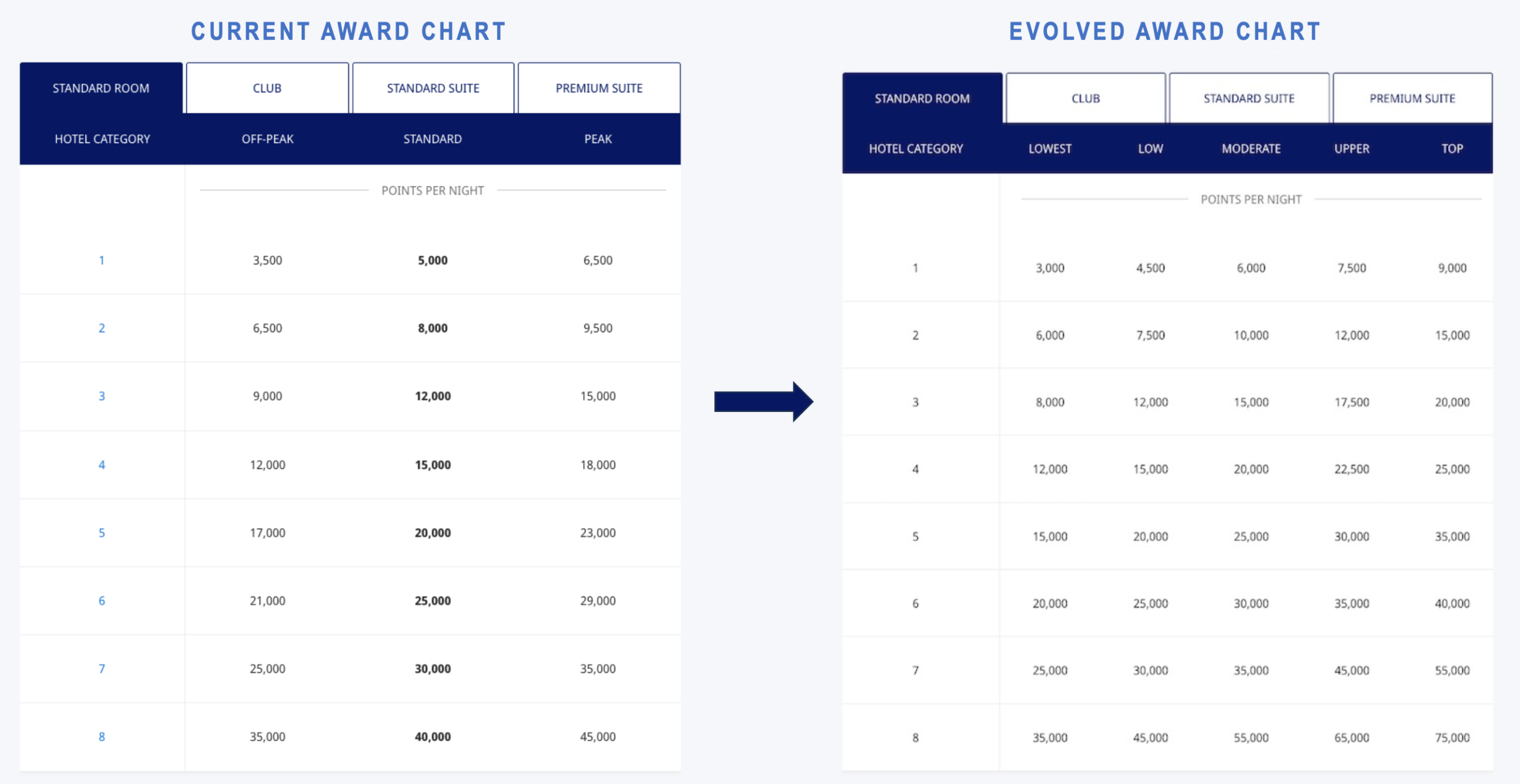
Hyatt insists the changes will be gradual and that the highest tiers will be used sparingly in 2026, with broader adoption coming in the years that follow.
Hyatt has also been clear that they’re committed to keeping a published award chart, which still puts them ahead of Marriott and Hilton on transparency. But the era of simple, predictable Hyatt award pricing is winding down, and programs that introduce dynamic-adjacent pricing levers tend to use them more over time … not less.
The Hyatt connection was the crown jewel of the Chase ecosystem – and a big reason many felt the 5/24 rule was worth paying attention to. That jewel is now accessible through Bilt, and it just got more expensive for everyone.
The Case for Points Diversification
For years, prioritizing Chase wasn’t something you had to think about too hard. Guard your 5/24 slots, get one of the Sapphire cards, earn Ultimate Rewards points, and transfer to Hyatt or other valuable Chase transfer partners. That was the playbook, and it was a good one.
What’s changed isn’t that Chase got bad – it’s that the specific advantages that made Chase the obvious default have eroded quietly, and from multiple directions at once.
Bilt now earns competitively and reaches the same core transfer partner destinations. The Reserve costs more than it delivers for many cardholders primarily using transfer partners, and Hyatt’s program is getting more complex and more expensive at the high end.
The Sapphire Preferred is still a great first card, and Chase Ultimate Rewards points continue to be worth earning. But if you’ve been following points and miles for a while and you’re still treating 5/24 like gospel and Chase like the only program worth building around, it might be time to revisit that assumption.
There are more reasons than ever to spread your points earning across programs … and fewer reasons than ever to put Chase at the center of all of it.
Bottom Line
Chase built its reputation on one era-defining card and one unrivaled hotel partnership. But the card’s new $795 price tag and benefits package falls flat compared to its primary competitors. Also, the Hyatt hotel partnership is no longer exclusive, and the program itself is raising its rates.
The Sapphire Preferred is still worth having, and Chase points are still worth earning. But the days of treating Chase as the automatic, unquestioned foundation of a travel rewards strategy are over.
Build your points and miles balances accordingly.




This is a brilliant read. Thank you for clarifying everything. One major concern I have is that it would seem the solution is to diversify – but put the most weight on the Bilt ecosystem. That seems like the Wild West at this point, given their poor rollout of 2.0. It is a gamble – one that could pay off in dividends or one that could end in ruins if transfer partners decide to walk away given Bilt’s mistakes.
One of the best features of CSR was the 3X on any travel. This made it easy for me to always use the CRS card for all travel. Now it is no longer my go to card for all travel. I have a suspicion that the reason that Chase revamped the CSR card was to provide smoke and mirrors around eliminating this key 3X on all travel benefit.
This is one more reason to support your approach of moving away from the CSR card.
Had a question. How would you compare the Chase cards (specifically the preferred) to the Schwab Amex Platinum? Thanks!
Great read and summary of the new landscape.
Thanks for reading, Ian!