


United Airlines is making one thing clear: If you want the most value from its MileagePlus program, you’d better have a United co-branded credit card. In a sweeping update announced Thursday, United said that starting April 2:
- Cardholders will earn significantly more miles on United flights than non-cardholders – in some cases nearly double or more
- … but that’s due in large part because non-cardholders will earn significantly fewer miles than they currently do
- And United basic economy tickets will no longer earn miles at all – unless you hold a United card
- All United cardholders will get at least a 10% discount on award redemptions on United-operated flights – similar to (but not quite as good as) Delta’s TakeOff 15 benefit, unless …
- You also have United Premier elite status, in which case you get 15% off award redemptions on United-operated flights
- The longtime perk of expanded access to “saver” award space – including Polaris business class – will still be available to cardholders
There’s a lot to unpack here. At first glance, this might seem like an improvement – and some of it truly is. But really, it signals a fundamental restructuring of United’s MileagePlus program: Holding a co-branded Chase card is becoming critical to earning and redeeming miles with United.
The days of transferring a boatload of Chase Ultimate Rewards points to get a good deal on a business class seat are over – let alone booking those United Polaris business class seats through a partner program like Air Canada or Avianca LifeMiles, as United has made that borderline impossible. The airline also likely forced both programs to raise award rates for United redemptions within the last year (or so).
That kind of transactional approach that award travel junkies seek out is dying. Instead, the more you engage with (read as: spend on) United, the better deal you’re going to get. This supercharges a strategy Delta enacted years ago with its TakeOff 15 benefit – a savvy way to generate the credit card signups and spend that airlines rely on to make most (if not all) of their money these days.
Here’s what you need to know about these changes – and what it all means.
Discounted Award Tickets
This is the most straightforward – and potentially valuable – part of the announcement.
Beginning April 2:
- All primary United cardholders will receive at least 10% off United award tickets
- Cardholders who have also earned elite status will receive at least 15% off
For example, a 15,000-mile economy ticket would drop to 13,500 miles (10% off) for cardholders. Meanwhile, a 200,000-mile Polaris business class award would fall to 170,000 miles (15% off) for members with Premier status.
In a world of dynamic award pricing – where mileage rates can swing wildly from one search to the next – a guaranteed 10% to 15% discount is meaningful.
But the cardholder discounts could potentially be much, much bigger.
More Saver Awards – Especially in Biz Class
For months, United has been displaying “special cardmember pricing” in award searches, showing lower mileage rates for cardholders alongside higher prices for non-cardholders.
Those savings can drastically dwarf the up to 15% discount United is adding. For example, we’ve seen United Polaris business class redemptions on cross-country routes for 80,000 miles … or just 30,000 miles if you have a United card.
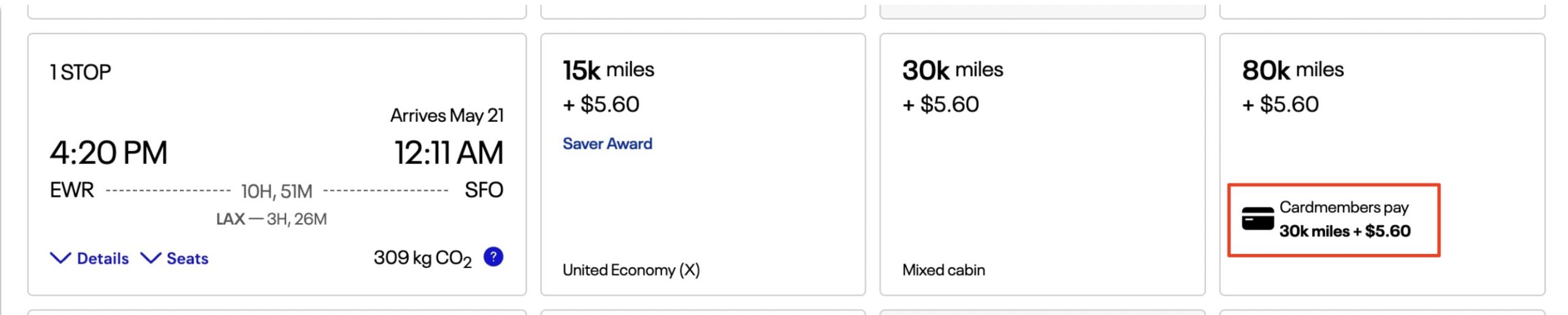
Now, that pricing model is becoming permanent and universal. With this announcement, United says it’s also expanding access to saver award space – United’s lowest-priced awards – for cardholders.
Under the new policy, general MileagePlus members with a United card will gain access to more Polaris saver inventory that was previously reserved for higher-tier elites. This is a different animal than those 10% to 15% discounts … and it’s potentially even better.
- That’s a flat discount: Just knock 10% or 15% off the mileage rate, whether it’s bringing a 10,000-mile domestic roundtrip to 9,000 miles or a 200,000 business class seat for as low as 170,000 miles
- This is different (and lower-priced) award inventory that everyday travelers won’t even see, which means those discounts could be even bigger
- Unlike those new up to 15% discounts, this even extends to redemptions on partner airlines like Lufthansa, Turkish Airlines, ANA, and more
This kind of special inventory is why everyday travelers are generally seeing sky-high redemption rates for business class awards. It’s the same reason why booking a United Polaris business class seat to Europe for 60,000 Air Canada Aeroplan points or 50,000 ANA Mileage Club miles has gotten impossible within the last year or so: United is reserving all that award space for cardholders and travelers with elite status.

With the new discount layered on top, United says Polaris saver awards to somewhere like London can price as low as 72,000 miles without status – or even better, 68,000 miles for members with Premier status.
United says about a third of flights with saver inventory are already earmarked for cardholders and elites – a benefit that has quietly become one of the strongest reasons to hold a United card. This announcement expands and formalizes that approach.
Of course, the key question is how much of that inventory will actually be available – especially during peak seasons and on the most popular routes.
Earn More Miles With a United Card … & Less Without One
United is also overhauling how members earn miles on paid tickets. The headline: Cardholders will earn “up to twice as many miles per dollar” as non-cardholders. But the fine print really matters here …
United isn’t just giving cardholders a boost, it’s cutting mileage-earning from a base rate of 5x miles per dollar for non-status holders to just 3x miles per dollar.
Under the new structure effective for tickets purchased as of April 2 and onward:
- Members with a *united explorer* will earn a total of 9x miles per dollar
- Members with a *united quest* will earn a total of 10x miles per dollar
- Members with a *united club* will earn a total of 11x miles per dollar
Those are competitive earn rates – and can be boosted as high as 17x with top-tier Premier 1K status – but only if you have a United card.

Notably, basic economy tickets will earn zero miles unless you hold a United co-branded card. United certainly isn’t the first U.S. airline to take this approach, though.
Late last year, American Airlines eliminated mileage earning on basic economy fares – copying a move Delta made years ago. Now United is effectively following suit – but with a twist: You can restore earnings if you hold their credit card.
This is less about rewarding loyalty by flying – and more about rewarding loyalty by swiping.
Related reading: Airline Loyalty Used to Reward Flying, Now It Rewards Holding a Credit Card
The Bigger Trend
This move fits into a broader pattern across the U.S. airline industry. Airlines don’t just sell seats anymore – they sell miles to banks. Co-branded credit card partnerships generate billions in revenue annually – more often than not, exceeding the money they make from flying alone.
Delta figured this out long ago, tying key benefits to its co-branded American Express cards. Even American has shown signs of shifting value away from its general members in an effort to boost its relationship with Citi.
Now, United is making card ownership central to earning and redeeming miles. The structure of MileagePlus is shifting from “fly more, earn more” to “swipe more, earn more” … and redeem more efficiently.
These moves are why we posed the question on a recent Thrifty Traveler Podcast: Is the points party ending?
Bottom Line
United just made its co-branded credit cards the gatekeeper to the best version of its MileagePlus loyalty program.
With this announcement, cardholders will earn miles faster, get an automatic 10% to 15% discount on every United award ticket, and see more “saver” availability. Meanwhile, non-cardholders will earn fewer miles and will be entirely shut out of earning miles on the cheapest, basic economy fares.
If you regularly fly United or redeem its miles, not having a co-branded card will soon cost you – either in slower earning or higher award prices.