


Last spring, we broke the news that all three of the nation’s largest airlines were quietly charging solo and business travelers significantly higher fares than groups of two or more. It caused a fierce backlash, hitting national news broadcasts and quickly forcing all but one carrier to quickly ditch the fares altogether.
A year and change later, two of the country’s biggest airlines are penalizing solo passengers more than ever.
Thrifty Traveler collected and analyzed 5,000 flights on the nation’s five largest airlines – 1,000 apiece, all nonstop domestic one-ways – on randomly selected routes over the next 11 months and found that two major U.S. airlines have leaned in, turning what was previously a rare pricing tactic into a frustratingly commonplace phenomenon:
- American Airlines was charging higher fares for solo passengers on 33.5% of flights, by an average of more than $90
- On United, we found higher solo passenger prices on 10.6% of flights – by just over $64, on average
Delta, Alaska, and Southwest did not charge higher fares for solo passengers on a single one of the 1,000 flights on each carrier we analyzed. Last year, Delta briefly employed this pricing tactic on select domestic routes before reversing course as it became national news – and the airline never resumed it.
But on American and United, the penalties for flying solo today range from mild to egregious. For example, American is charging $496 for a one-way flight from Miami (MIA) to Charlotte (CLT) for a single traveler.
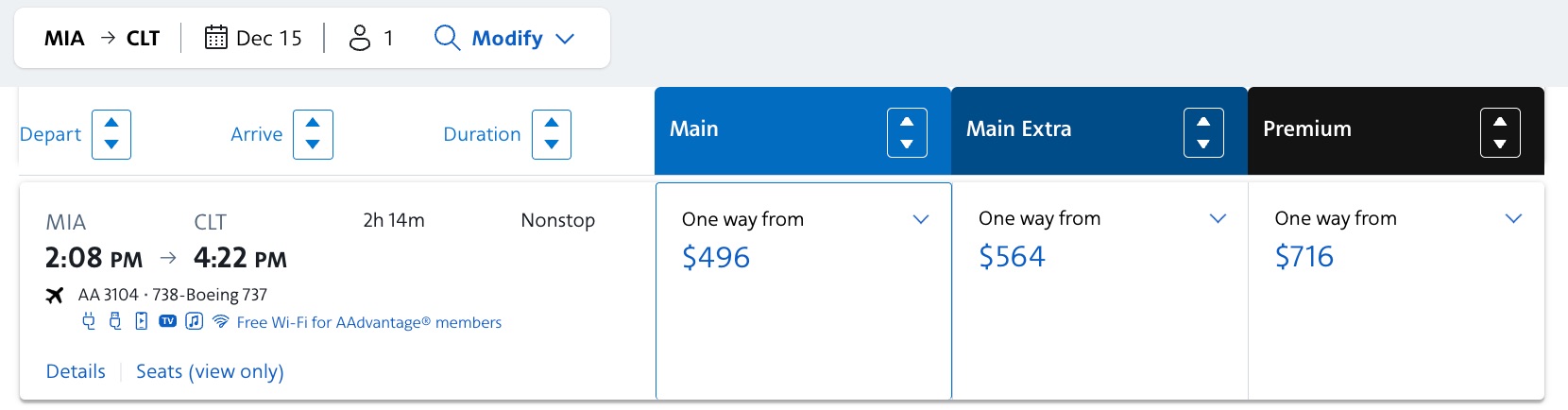
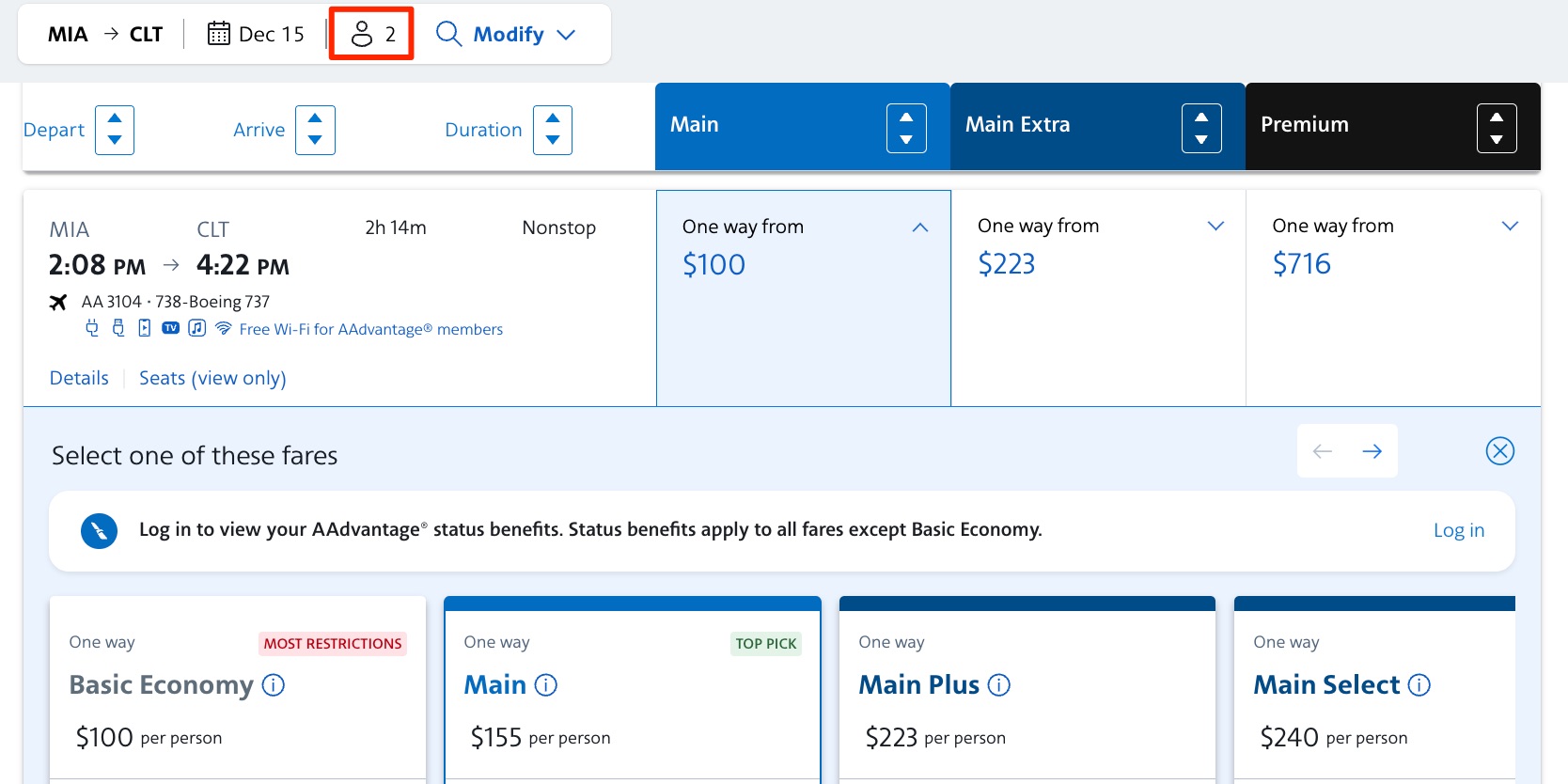
But add a second (or third) passenger to that search, and the price for that exact same main cabin economy fare drops to just $155 apiece, meaning you can book three passengers for less than the price of one. Plus, an even cheaper $100 basic economy fare is bookable for a group of two or more – an option that wasn’t available when searching for just one passenger.
While more rare, both carriers have also expanded this pricing tactic to some domestic roundtrip flights – not just one-way flights. And American is even occasionally charging higher fares for single passengers on short-haul international flights, like to Mexico or the Caribbean.
American Airlines did not respond to several requests for comment on this story this week. United declined to comment.
It adds insult to injury at a time when many American travelers are already wincing at flight prices. Airfare is up more than 25% on average compared to last year since the war in Iran triggered a fuel shock. Some flights are twice the price or more as a year ago.
Airlines are already under scrutiny for their pricing. Many members of Congress called Delta’s use of AI to set airfare into question last year amid growing concerns that it could use individual data to personalize pricing – something Delta has repeatedly denied. Just this week, the Federal Trade Commission (FTC) ordered Delta, JetBlue, and United – among other large corporations – to provide information on how they may be using consumer information to set prices.
That’s a growing concern in the age of algorithms and AI. So far, there’s little – if any – proof that airlines are engaging in “surveillance prices.”
But these higher fares for solo and business travelers are a reality. And they keep getting worse.
A Penalty for Solo Flyers, Not a Discount for Groups
Last year’s blowup was a clear sign: Americans don’t trust airlines. And airfare pricing is a black box to even savvy travelers.
How airlines set prices is enormously and impenetrably complex, with prices that sometimes seem to change by the second. And they’re notoriously secretive about the inner workings of how they price their fares and why. They make matters worse by constantly rebranding their ticket types or imposing new policies and restrictions while two of them – Delta and American – arguably engage in a form of bait-and-switch pricing.
Critics and even former airline CEOs have argued that this pricing mechanism could just as easily be a discount for larger groups as it is a penalty for flying solo.
But airlines are not Costco or Target, and plane seats are certainly not gallons of milk or packages of meat with clearly advertised, (relatively) stable pricing. Bulk pricing discounts are not a thing for plane tickets – at least not typically. And now more than ever, airlines are not in the business of cutting passengers a better deal than they absolutely have to.
And there’s additional evidence that airlines are using these fares to get more money out of solo and business travelers – especially at American, which has been using this pricing tactic longer … and employing it more broadly.
On the routes we searched, where American was charging single passengers higher fares on some dates but equal fares on others, the average fares for groups of two or more were also slightly higher when a solo passenger penalty was present. If this were truly a discount, you’d expect the opposite.
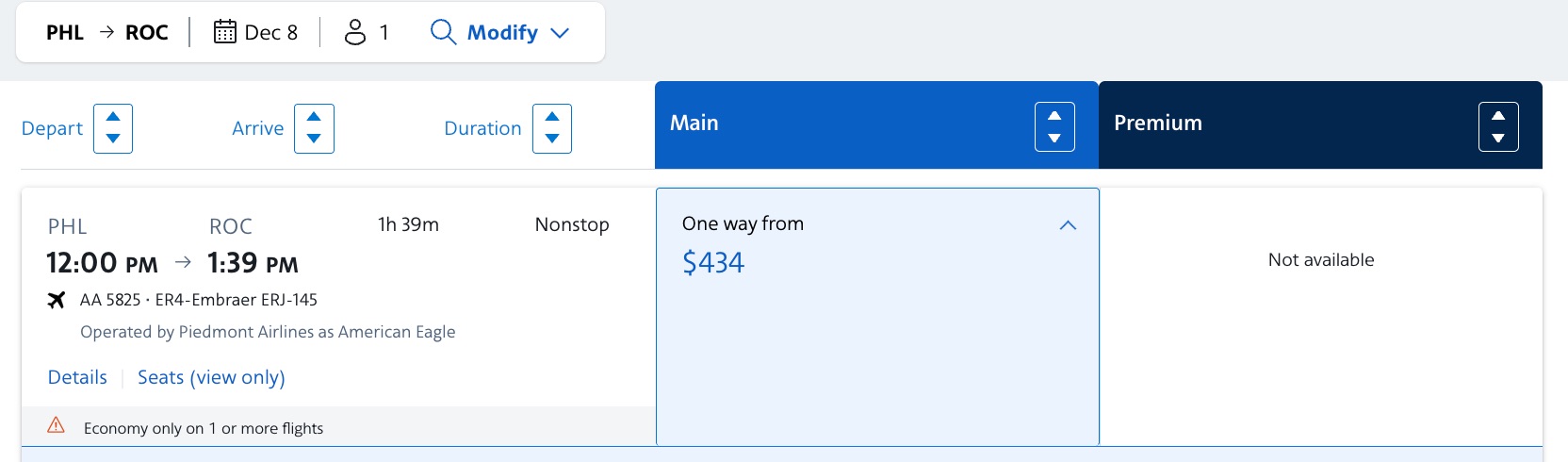
For example, our analysis logged three identical flights from Philadelphia (PHL) to Rochester (ROC) on three different dates with a remarkably consistent average fare of roughly $307 per passenger, whether you’re booking for one traveler or two … except on Dec. 8, when it charged a whopping $434 for a single traveler for the same main cabin economy ticket. That’s nearly $120 more than what American is charging on other Philly-to-Rochester flights we recorded.
Plus, it’s telling where American is using this fare tactic most frequently: at the hubs where it dominates.
While just over a third of the American fares we analyzed showed higher fares for solo passengers, that share jumps to nearly 60% for flights to and from Philadelphia … and to 65% for flights to and from Charlotte (CLT). Yet these higher fares for solo passengers are far less present at the airline’s biggest hub of all: Dallas-Fort Worth (DFW).
On both carriers, this pricing dynamic is far more prevalent on routes where they have a monopoly than routes where they go head-to-head with with two or more other airlines. Logically, a true discount for two people or more would make more sense when they have competition … whereas they know they can get away with charging higher fares when they’re the only option.
There are exceptions, of course. And that case isn’t quite as strong with United, which isn’t charging these different fares for solo travelers nearly as often as American. In some instances, United’s use of this pricing strategy looks more like a discount for traveling companions than a penalty for booking for one.
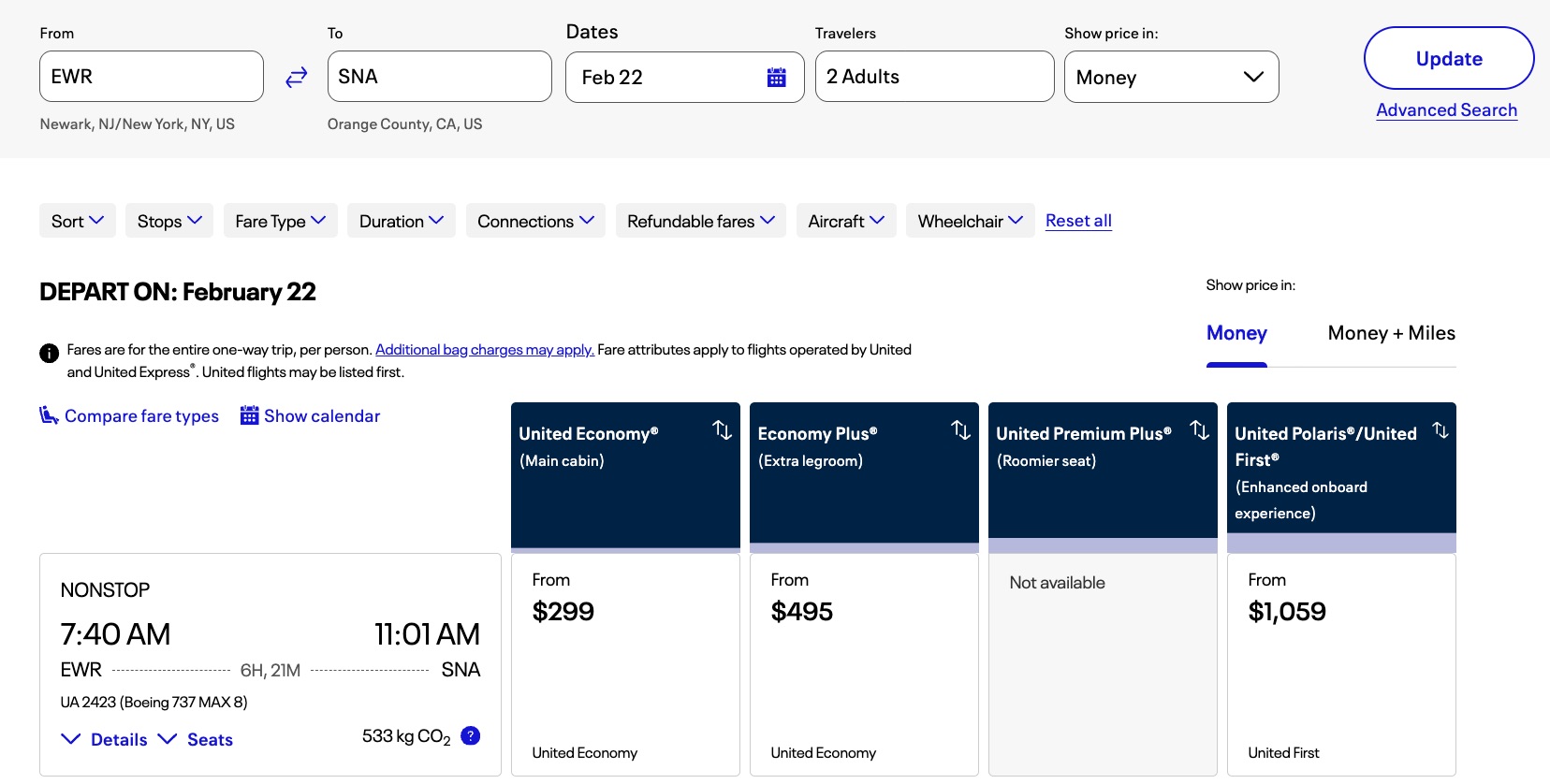
But it still happens, as with this flight from Newark (EWR) to Santa Ana (SNA) in Orange County. Search for one traveler on Feb. 22, and you’ll see main cabin economy for $404.
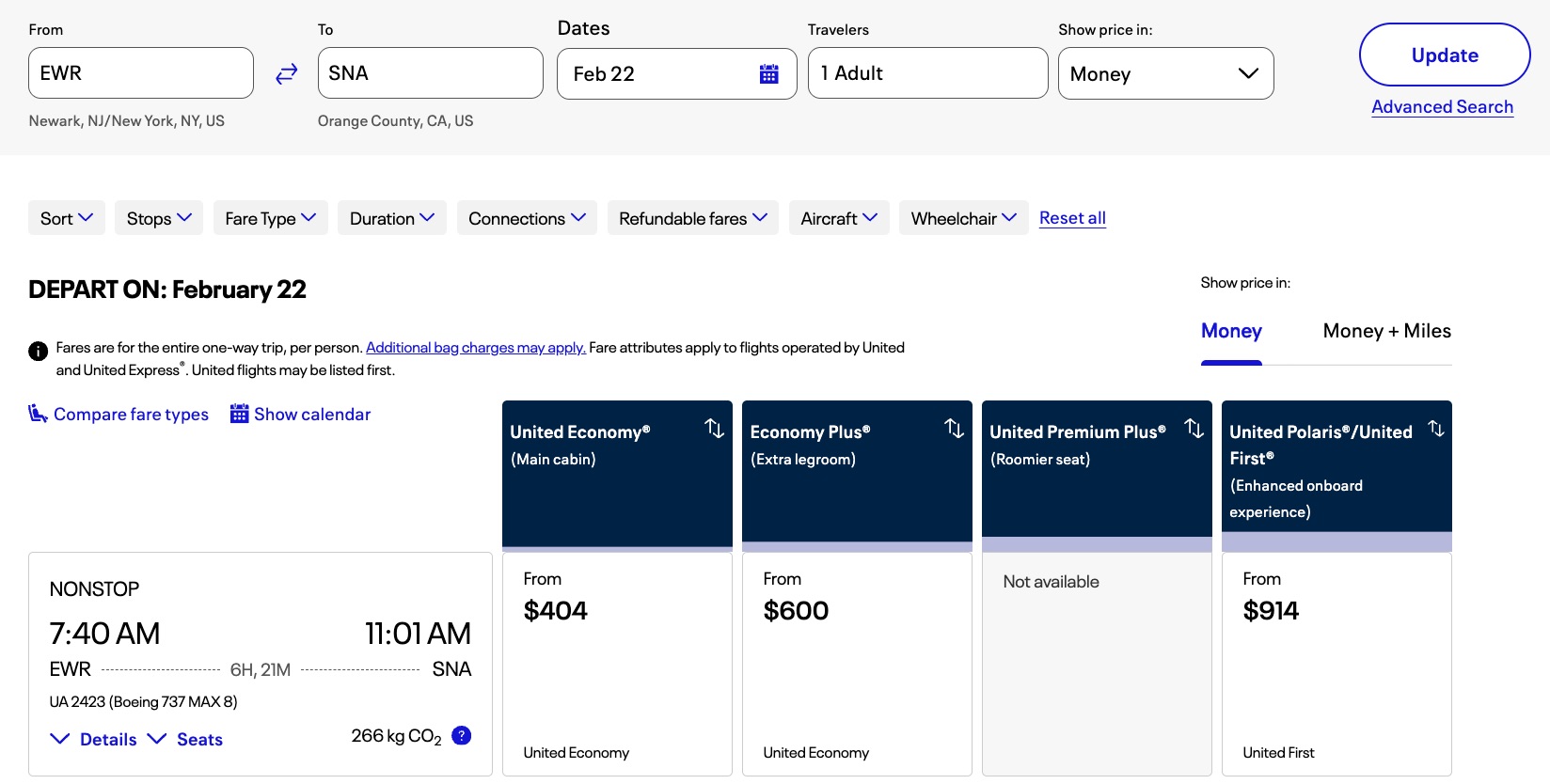
But add a second passenger to your search, and that exact same fare drops by more than $100 per person.
But Why?
This isn’t just unusual. Until this first surfaced last year, this kind of higher pricing for one passenger is the exact opposite of what we typically see.
It’s no less frustrating, but travelers booking for two or more passengers wind up being charged more per person than a single passenger. That comes down to the mechanics of how airlines actually sell tickets: Carriers aren’t just selling economy, extra legroom, and first class tickets but an alphabet soup of different fare classes, each at a different price. If there’s only one fare available at the cheapest $118, searching for two would only yield fares at a higher, $199 price point.
This tactic flips that on its head. But why?
Again, airlines aren’t talking. None of them responded to requests for comment. But that doesn’t mean we don’t know their motivation here.
It’s all about “segmentation.”
Airlines are always trying to cater to different kinds of customers at once: money-conscious budget travelers, families going on vacations or visiting relatives, wealthy retirees, business travelers, and more. And each one is willing to click that “purchase” button at a different price.
That’s why basic economy exists – to compete with budget airlines for the cheapest consumers while selling better tickets at higher prices. It’s why they’ve started rolling out basic business and first class fares. And it’s why most airlines charge higher prices in the final two or three weeks before departure.
And we’re guessing it’s why these two airlines are charging some solo flyers more, too: They’re more likely to be business travelers flying on their employer’s dime … and thus less likely to care about paying another $80, $100, or even $300. With flight prices up across the board, further penalizing solo travelers is another easy way to pass more of their costs on to consumers.
And they do that in the arcane world of fare rule, where airlines carve out requirements and exceptions in order to sell tickets at a certain price. While virtually no travelers ever read them, these rules are publicly accessible using an advanced airfare search engine like ITA Matrix.
Right there in the cheaper fare for two, the airlines break out “accompaniment restrictions,” spelling out that the traveler “must be accompanied on all sectors in the same compartment by at least 1 adult.”
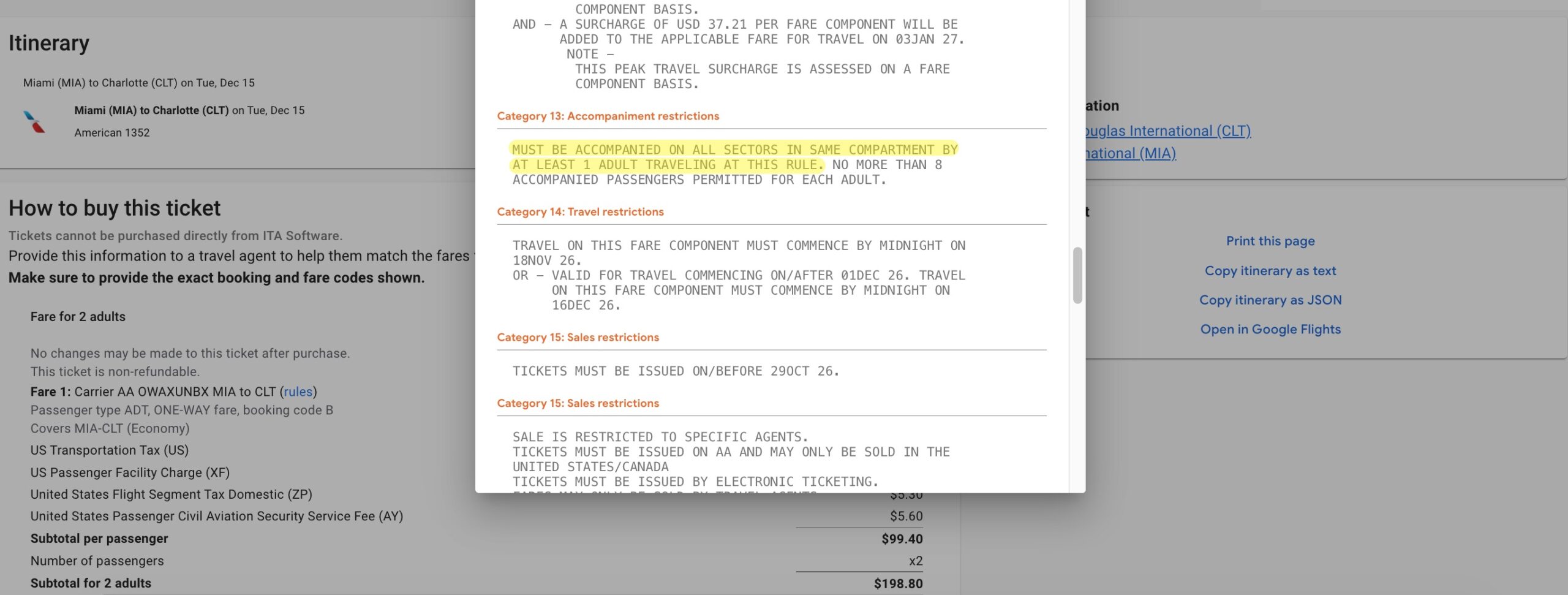
With that rule in place, anyone searching American Airlines from Miami to Charlotte for just one passenger won’t even see this $99-apiece fare on Google Flights or AA.com – only the one clocking in at $496.
Of course, not all travelers booking solo tickets are charging flights to a corporate card. There are travelers content to travel solo and flyers heading out to attend to a family emergency. Friends booking flights separately; spouses going on a trip who leave a day or two apart. And many, many more.
Bottom Line
The so-called “solo traveler tax” hasn’t disappeared. It’s getting worse.
When we first broke the news about this pricing tactic last year, higher fares for solo passengers were somewhat rare and random. Our latest analysis shows it’s now fairly widespread – especially on American Airlines.