




Timeshares have a bad reputation … for a reason.
The major hotel chains – including Marriott, Hilton, and IHG – all have vacation club programs where owners buy the right to stay at a property (or collection of properties) for a certain amount of time each year. In theory, it sounds great: Lock in future vacations and enjoy resort-style accommodations for years to come.
In practice? It’s usually not that simple.
This story originally appeared in our free daily newsletter, The Extra Mile – sign up now to get stories you won’t see here, exclusive deals, and more in your inbox every weekday!
Most timeshares come with hefty upfront costs, annual maintenance fees that seem to rise forever, limited flexibility, and resale values that often fall off a cliff. You don’t really “own” real estate in the traditional sense, and getting out of a timeshare can be far more difficult than getting into one.
That’s not to say they can’t work for some travelers – plenty of owners genuinely enjoy them – but most savvy Extra Mile readers will likely get better value redeeming points and miles for similar stays. (Disney Vacation Club might be the notable exception.)
But while buying a timeshare isn’t usually a great deal, trying one out can be.
Every so often, these vacation clubs roll out (sometimes targeted) promotional offers designed to get travelers in the door. The deals can be surprisingly good:
- Westin Vacation Club (Marriott): 5 nights in a studio villa at the Westin Ka’anapali in Maui for $999 + 25,000 Marriott Bonvoy points
- Holiday Inn Club Vacations (IHG): 3 nights in destinations like Myrtle Beach, Orlando, or Las Vegas + 50,000 IHG One Rewards points for $249
- Hilton Grand Vacations (Hilton): 2 nights in New York City + 100,000 Hilton Honors points for $250
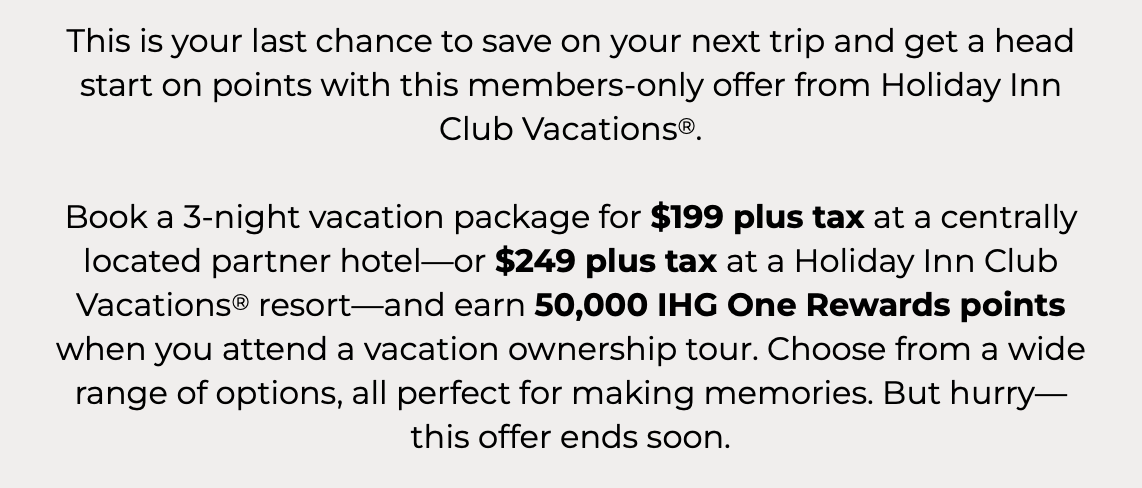
In some cases, the discounted rate alone can be 75% less than booking outright. Take the Westin Ka’anapali: It’s not uncommon to see rates north of $800 per night. Getting roughly $4,000 worth of hotel nights for $999 is compelling enough before you even factor in the bonus points.
Of course, there’s a catch: To qualify for these deals, you’ll almost always need to sit through a timeshare presentation.
If you’ve never experienced one before, “presentation” is a very generous term. Think high-pressure sales pitch, multiple closers, and plenty of attempts to wear down your resistance. If you’re not interested in buying, you’ll need to be comfortable saying “no” repeatedly – and sticking to it.
I’ve taken advantage of a similar offer myself through Sheraton Vacation Club in Orlando. The savings weren’t quite as dramatic, and the points bonus was smaller, but there wasn’t a required presentation (though they certainly tried to schedule one at check-in).
For the right traveler, these offers can be an excellent way to stay somewhere far nicer than you’d normally book while paying a fraction of the price. For others, the thought of spending even an hour or two in a timeshare sales pitch is enough to make it an automatic pass.
What about you? Have you ever taken advantage of one of these offers – or would the presentation be a dealbreaker?
This story originally appeared in our free daily newsletter, The Extra Mile – sign up now to get stories you won’t see here, exclusive deals, and more in your inbox every weekday!